.svg)
Short answer
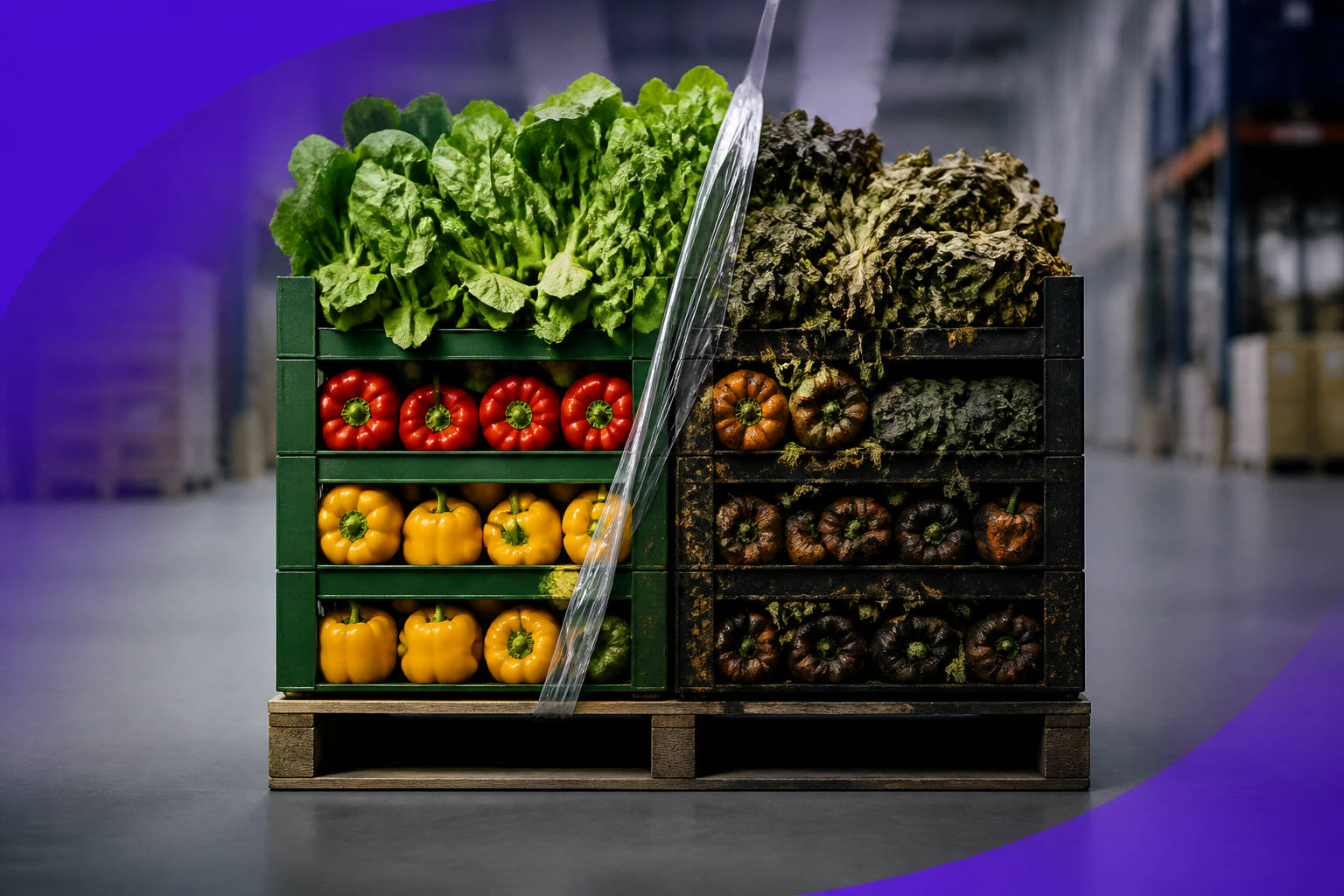
AI in supply chain prevents spoilage by integrating data analysis, automation, and predictive modeling into logistics, planning, and inventory decisions. It identifies patterns in product condition, movement, and operating history, flagging potential risks early. This proactive approach allows teams to intervene and protect goods before quality is compromised, ultimately reducing waste and improving efficiency across the supply chain. Source: Wiliot Temperature Monitoring
AI in supply chain is the use of data analysis, automation, and predictive modeling to make planning, logistics, inventory, and risk decisions before goods are wasted. In practice, artificial intelligence enhances supply chain operations by optimizing planning, predicting demand, streamlining logistics, and improving visibility through data analysis, automation, and predictive modeling, which can increase efficiency, reduce costs, and improve risk management, including temperature control in cold storage and refrigerated trucks that can reduce fresh produce spoilage by 8-12%.
How is AI in supply chain used to predict and prevent product spoilage?

AI in supply chain prevents spoilage by reading patterns in product movement, product condition, inventory status, and operating history, then warning teams when a shipment or batch is likely to fall out of acceptable condition.
Spoilage prediction starts with condition and time
The simplest version is familiar to any cold-chain quality lead: a product has a temperature range, route, dwell time, and remaining shelf-life expectation. AI compares what is happening now with the patterns that usually lead to waste, then flags risk earlier than a manual review would.
That timing matters because spoilage is often caused by small delays and weak signals rather than one obvious failure. A pallet may sit too long at receiving, a trailer may warm during a handoff, or inventory may be recorded in the wrong place. AI helps when it turns those signals into an alert or risk score tied to a recommended action while there is still time to protect the product.
Prevention depends on acting before the product fails
Prevention starts before the postmortem. In supply planning, AI can analyze transactional data and keep operating parameters such as lead times current, which matters because updated lead-time parameters are critical for scheduling. If lead times drift and the system does not notice, perishable goods can be ordered, staged, shipped, or replenished on assumptions that are already wrong.
For spoilage, the useful pattern is practical:
- Predict demand so teams do not overstock products with short shelf lives.
- Monitor condition so temperature or dwell problems are seen before quality is lost.
- Improve inventory availability so older, at-risk goods are found and moved first.
- Update planning inputs so routes, lead times, and replenishment windows reflect actual operations.
- Trigger verification when the model sees risk but a human decision is still needed.
Spoilage prevention is a timing problem. AI is useful when it moves the decision from "what went wrong?" to "what should we do while the product can still be saved?"
What AI knows, and what it doesn't yet
AI in supply chain work gets harder when the data moves farther away from the product. A model can know a lot about facilities, routes, orders, and historical performance, but spoilage prediction is much weaker when the model cannot see the condition of the actual goods.
Most systems know the air around the product
A cold room sensor can tell you the room temperature. A truck sensor can tell you the trailer temperature. A warehouse system can tell you what should be in a location. Those signals matter, but they are still indirect.
Indirect signals can hide item-level reality. One case may sit near a dock door while the rest of the pallet stays cold. One tote may miss a handoff. One reusable container may dwell at a store or carrier site longer than the route plan expected. A model that sees only averages may treat those products as healthy when their actual journey says otherwise.
Spoilage risk lives at the product level
Strong spoilage decisions depend on knowing whether the product stayed within acceptable condition during its own journey. That requires item-level visibility, condition history, and location context at a level fine enough to separate one product, tote, crate, or pallet from another.
As of 2026, logistics leaders are also facing a trust problem. The 35th Annual Study of Logistics and Transportation Trends described the next operating challenge as knowing when to trust-and when to verify as AI adoption accelerates and new risks reshape logistics. That phrasing fits spoilage work exactly: a prediction is useful only if the team knows when to act on it, when to check it, and when to override it.
The practical visibility gap
The practical gap looks like this:
- Facility-level data can show whether a room, trailer, or lane had a problem.
- Shipment-level data can show whether an order or pallet was delayed.
- Item-level data can show which physical products were exposed, where they were, and for how long.
- Workflow data can show whether anyone acted on the alert before the quality window closed.
Key AI concepts for supply chain leaders
Supply chain leaders need a shared vocabulary before they can judge whether an AI project is ready for spoilage prevention. The model, data, decision, and physical goods each have a separate role, and mixing them together is how teams end up with impressive dashboards that do not protect product.
Predictive analytics
- Predictive analytics is the use of historical and current data to estimate what is likely to happen next.
- In spoilage prevention, predictive analytics might flag a batch, route, store, trailer, or container as higher risk because its time, temperature, location, or handling pattern resembles past waste events.
- The prediction is only as useful as the data behind it, so a clean forecast built on weak product visibility can still miss the products that are actually at risk.
Machine learning
- Machine learning is a way for software to find patterns in data without a person writing every rule by hand.
- In cold-chain operations, machine learning can learn that certain combinations of route delay, receiving dwell, product type, and temperature exposure often lead to spoilage.
- The model does not "understand" food quality the way a quality manager does. It learns from signals, labels, and outcomes.
Digital twin
- Digital twin means a digital model of a physical process, asset, product flow, or facility.
- In supply chain work, a digital twin can help teams test how a route, plant, warehouse, or inventory flow behaves under different conditions.
- In January 2026, PepsiCo announced a multi-year collaboration with Siemens and NVIDIA to use AI and digital twin technology in plant and supply chain operations, which shows how the concept moved from planning language into operating programs.
Agentic AI
- Agentic AI refers to AI systems that can carry out tasks, not just present analysis.
- As of 2026, KPMG described supply chains moving from standalone AI pilots toward AI embedded in platforms like Source-to-Pay, and in supply chain planning and risk management tools, with agentic AI performing tasks such as supplier evaluation, risk monitoring, and contract review as part of broader supply chain AI strategy.
- For spoilage, agentic AI should be treated carefully. Recommending that a shipment be inspected is different from automatically rejecting product, changing allocation, or rerouting inventory.
Master data
- Master data is the trusted reference data the business depends on, such as product IDs, pack sizes, temperature requirements, shelf-life rules, supplier records, facility IDs, lanes, and customer locations.
- If master data is wrong, the model can make confident decisions from bad assumptions.
- By the end of 2026, supply chain AI discussions were expected to shift from choosing an AI vendor to asking whether master data is ready for any agent at all, according to Forbes coverage of the next phase of supply chain AI.
The data prerequisites: sensing the product, not just the air
Spoilage prevention depends on applying those AI concepts to the right evidence. AI in supply chain needs physical-world data close enough to the product to tell whether the actual goods, not only the facility around them, stayed inside the quality window.
The minimum useful data set is operational, not exotic
The inputs for spoilage prediction are not mysterious. They are the same things quality, logistics, and inventory teams already argue about after a waste event, only captured earlier and more consistently.
For perishable goods, the core data set usually includes:
- Product identity, so the system knows what item, lot, case, tote, pallet, or container is being assessed.
- Location history, so the system can see where the product moved and where it dwelled.
- Condition history, especially temperature, and where relevant humidity or other environmental readings.
- Time in state, because five minutes at a dock door and five hours at a dock door are different risks.
- Handling events, including receiving, staging, dispatch, handoff, return, and exception events.
- Inventory status, so the system knows whether the product is available, misplaced, delayed, or recorded inaccurately.
- Quality outcome labels, so the model can learn which journeys led to acceptable product and which led to waste.
NIST AMS 100-75 (February 2026) work on AI in supply chain processes found diverse AI applications across Plan, Source, Make, Deliver, and Return in the SCOR model. That matters because spoilage risk crosses all of those process boundaries instead of sitting neatly inside transportation or warehousing. The NIST AMS 100-75 supply chain AI workshop results make the point indirectly: the data problem is end-to-end.
Product sensing closes the cold-chain blind spots
A room sensor can support compliance records, and a truck sensor can help identify route problems. But neither signal automatically proves that every product inside stayed within the right condition range for the right amount of time.
Continuous condition sensing
Continuous condition sensing changes the quality conversation because it brings the evidence closer to the product. Wiliot is a Physical AI company that gives organizations continuous, scan-free visibility into the location and condition of every item in their supply chain. Battery-free IoT Pixels capture that data, and the Wiliot Physical AI Platform refines it into actionable insights, predicting problems that include shrink and mis-ships as well as spoilage, and recommending the next move.
For cold-chain teams, the important shift is from checking points to reading journeys. A product can be acceptable at dispatch and unacceptable by receiving. It can be inside a compliant facility while sitting in the wrong micro-location. It can be counted in inventory while physically unavailable for use.
What the model must connect
The most useful spoilage model can connect:
- Where the product was
- What condition it experienced
- How long the exposure lasted
- Which operating step created the risk
- What action is still possible
Teams building that foundation often start with temperature records because the decision clock is visible and operationally painful. A related guide on cold chain temperature monitoring records is a useful next read if the immediate problem is deciding what kind of condition evidence the business can trust.
The workflow prerequisites: when to trust, and when to verify
Better data only matters if the operation can act on it. AI in supply chain prevents spoilage when alerts fit the way people actually receive, inspect, move, hold, release, or reject goods.
Alerts need owners, thresholds, and time limits
A spoilage alert without an owner is just another dashboard tile. Quality teams, warehouse supervisors, transportation coordinators, and inventory planners need to know who responds, how fast, and what evidence counts.
The operating model should define:
- Who receives the alert, such as quality, receiving, transportation, or inventory control.
- What the alert means, such as inspect, prioritize, hold, reroute, allocate first, or investigate.
- What evidence confirms the risk, such as product temperature history, dwell duration, shipment history, or physical inspection.
- How long the decision window stays open, because a useful alert can become stale quickly.
- Who can override the recommendation, especially when customer service, food safety, or commercial commitments are involved.
The "trust and verify" idea matters because AI may identify a high-risk shipment, but the business still needs a verification path before turning that prediction into a costly hold, rejection, or disposal decision.
Human review is a control, not a weakness
Human-in-the-loop workflows are sometimes framed as a sign that AI is immature. In spoilage prevention, they are a practical control. The model can see patterns across more data than a person can review manually, but people still understand context the model may not have, such as a known customer requirement, an active recall process, or a receiving team's local constraint.
The stronger workflow pairs model output with evidence:
- Low-risk products can flow normally when condition history and inventory status match expectations.
- Medium-risk products can be prioritized, inspected, or moved first.
- High-risk products can be held, rerouted, or escalated for quality review.
- Uncertain products can trigger verification rather than automatic action.
For operations that need scan-free condition evidence, temperature monitoring tied to item-level visibility gives teams a way to see location and condition together instead of chasing separate records after the product has already moved.
AI does not remove judgment from spoilage decisions. It changes when judgment happens, what evidence is available, and how much product is still recoverable when the decision is made.
Next steps: preparing your data for AI in 2026
AI in supply chain should start with data readiness and sensing coverage, with workflow design settled before a company worries about advanced automation. Spoilage prevention is an operational problem first: the business has to know which records the model can trust and where product visibility drops out. It also has to know who acts when the system flags risk.
Start with the records the model must trust
The first practical step is to audit the data that spoilage decisions already depend on. Product IDs, shelf-life rules, storage requirements, supplier records, route definitions, facility locations, and handling events need to be consistent enough for a model to use without guesswork.
A useful readiness check includes:
- Master data quality, including whether product, location, and supplier records are complete.
- Condition data coverage, including where temperature or dwell history is missing.
- Inventory accuracy, including whether physical goods match system records.
- Exception labels, including whether waste, rejection, delay, and quality outcomes are recorded in a usable way.
- Decision workflows, including whether alerts have owners and response rules.
Build toward item-level visibility
The second step is to improve how the business sees physical goods between manual scans and fixed read points. Spoilage often develops in the gaps, at handoffs or during dwell, including inventory that looks correct in the system but is wrong on the floor.
Physical AI gives operators continuous, item-level, scan-free reading of physical goods, creating digital identity for physical products and turning physical-world data into inventory insights. That matters because the model needs a clean connection between the record and the product.
Narrow the first operating question
As of 2026, the most sensible path is to avoid chasing the broadest AI promise and answer the narrower operational question first: which products are at risk, why, where are they, and what action is still available? Once that question is answerable, AI becomes less abstract and far more useful.
Frequently asked questions
How do I use AI in supply chain to predict and prevent product spoilage?
AI predicts spoilage by combining product identity, location, condition history, dwell time, inventory status, and past quality outcomes to estimate which goods are at risk. It prevents spoilage when those predictions trigger action early enough, such as inspecting a shipment, prioritizing at-risk stock, rerouting goods, or correcting a handoff delay before product quality is lost. Source: Wiliot Temperature Monitoring
What kind of data do I need before AI can help prevent spoilage?
You need trusted product master data, clear shelf-life and temperature rules, reliable location history, condition data, and records of what happened to products after exceptions. AI cannot make strong spoilage predictions from facility averages alone. It needs data close to the product and clean enough to connect a physical item with its digital record. Source: Wiliot Physical AI platform
How is AI being used in supply chains as of 2026?
As of 2026, AI is used in supply chain planning, demand forecasting, risk monitoring, logistics decisions, procurement workflows, inventory analysis, and exception management. In spoilage-related work, the most useful applications connect planning data with physical-world data so teams can see risk early and make better operating decisions. Source: Wiliot Inventory Intelligence
What is the difference between AI knowing the air and knowing the product?
Knowing the air means the system can see the temperature of a room, trailer, or storage zone. Knowing the product means the system can connect condition and timing to the actual location of the item, tote, case, pallet, or container. Spoilage decisions are stronger when they are based on the product's own journey rather than only the environment around it. Source: Wiliot IoT Pixels
What should my company do first to prepare for using AI in our supply chain?
Start by cleaning the data that AI must trust: product records, location records, supplier records, shelf-life rules, temperature requirements, handling events, and exception outcomes. Then look for blind spots where product condition or inventory status disappears between scans, facilities, or handoffs. Better AI decisions begin with better physical-world data. Source: Wiliot Physical AI platform
Sources
Every reference cited on this page, in the order Wiliot evidence, related articles, then outside research.
- 1.temperature monitoring (wiliot.com)
- 2.Wiliot Inventory Intelligence (wiliot.com)
- 3.temperature control in cold storage and refrigerated trucks (bcg.com)
- 4.How is AI in supply chain used to predict and prevent product spoilage? (kkkcdzmhnnqevxhexzpo.supabase.co)
- 5.knowing when to trust-and when to verify (logisticsmgmt.com)
- 6.AI and digital twin technology in plant and supply chain operations (inboundlogistics.com)
- 7.supply chain AI strategy (kpmg.com)
- 8.Forbes coverage of the next phase of supply chain AI (forbes.com)
- 9.NIST AMS 100-75 supply chain AI workshop results (nvlpubs.nist.gov)
- 10.What AI knows, and what it doesn't yet (kkkcdzmhnnqevxhexzpo.supabase.co)