.svg)
Short answer
Bluetooth beacons can enable signals to arrive before product decisions by broadcasting identifiers and condition data to nearby receivers. This allows supply-chain teams to gain real-time location context and condition monitoring for assets, identifying issues like temperature deviations or misloads before a handoff, which reduces errors and waste. Source: Wiliot Temperature Monitoring
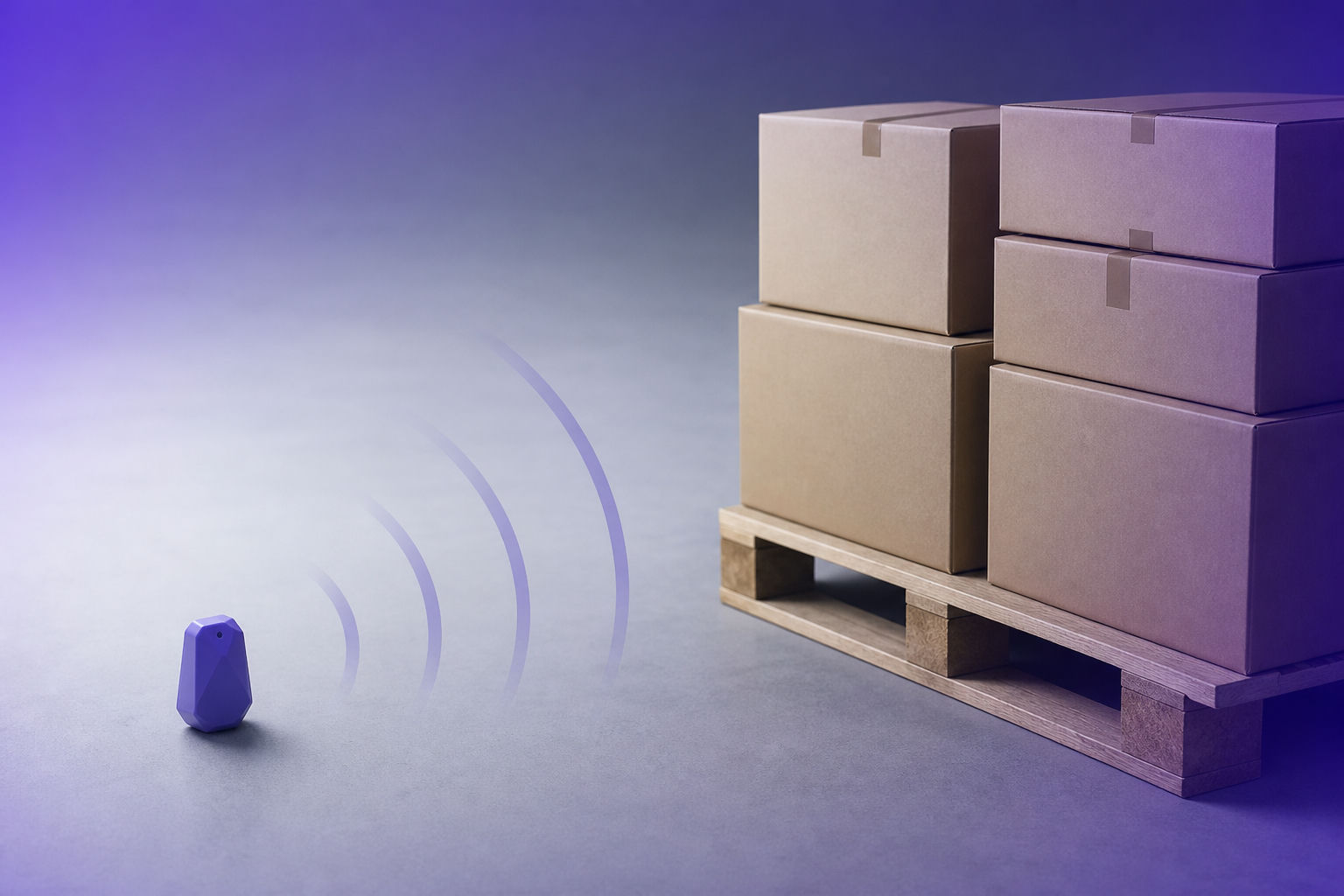
A Bluetooth beacon is a small, low-power wireless transmitter that uses Bluetooth Low Energy (BLE) to broadcast signals, enabling location tracking and condition monitoring of assets like reusable containers or perishable goods within a supply chain. As a class of BLE device, Bluetooth beacons broadcast an identifier to nearby portable electronic devices so a receiving system can recognize what is nearby and act on it.
What is a beacon Bluetooth signal?

A beacon Bluetooth signal matters because supply-chain decisions often depend on knowing what moved and where it was heard, with any condition change captured before the next handoff. In plain English, the signal is a short wireless broadcast that says, "this tagged thing is here, and here is a small packet of related data."
A beacon is a broadcaster, not a conversation
A Bluetooth Low Energy beacon does not need to hold a long two-way session to be useful. BLE is a low-energy form of Bluetooth built for efficient short-distance communication, which is why beacon systems fit indoor supply-chain settings where goods move through doors, coolers, docks, back rooms, and store shelves.
In practical terms, a beacon repeats an identifier. A nearby phone, scanner, gateway, or other receiver hears that identifier, matches it to a record, and records the event.
The identifier creates the product record
The identifier is the bridge between a physical object and a digital record. For supply-chain teams, that object might be a tote, crate, pallet, reusable container, case, or perishable product moving through a controlled environment.
A useful beacon event usually contains three ideas:
- Identity, meaning which object, container, or product was detected.
- Place, meaning where the receiver was when it heard the beacon.
- Condition, meaning sensor data such as temperature when the beacon or connected device supports it.
A BLE beacon does not "know" the whole supply chain by itself. It broadcasts enough identity and condition context for the surrounding infrastructure to build a usable history.
How BLE beacons provide location and condition data
BLE beacons provide location and condition data by broadcasting a small signal again and again, then letting nearby receivers interpret that signal as proximity, presence, movement, or a sensor-linked status change. Once identity exists, the next question is whether the read gives operators enough context to act.
Proximity turns a radio signal into location context
A proximity event starts when a receiver hears a beacon in range. Beacons are often used for internal location because they can detect a precise location within a narrow range, and research on location-aware technologies describes them as small devices used where more accurate indoor information is needed through precise location within a narrow range.
That location is usually practical rather than cinematic. It may mean "this reusable container is near dock door 12," "this pallet is inside the chilled staging area," or "this tote passed the receiving point."
Range is useful, but context decides accuracy
BLE range is part of the appeal, especially indoors. Bluetooth beacons can track location from inches to about 50 meters, use little energy, and work well indoors, according to a New York Times explanation of Bluetooth beacon range and indoor behavior.
That range does not make every read perfect. Warehouses have metal racks, moving forklifts, stacked goods, human bodies, cold rooms, and loading bays, and each one can affect how a signal is interpreted.
A good system reduces ambiguity with multiple context clues:
- Receiver position, such as a dock gateway, handheld scanner, or fixed reader.
- Signal strength, which can suggest relative distance.
- Time sequence, because the order of reads often shows direction of travel.
- Business rules, such as whether a product should be in chilled storage or ambient staging.
- Condition thresholds, such as whether a temperature reading is outside an allowed band.
BLE standards have improved ranging
Ranging has become more exact as Bluetooth standards have changed. Bluetooth LE specification 5.1 added more precise methods for position determination using multiple beacons, while Bluetooth Core Specification 6.0, adopted in September 2024, introduced Channel Sounding for more accurate distance and direction estimates, and Bluetooth Core 6.2 (November 2025) refined that area with attack-resilience work for spoofing risk, as described in the Bluetooth Low Energy specification history.
For a quality leader, better ranging matters because a temperature deviation is rarely judged in isolation. The decision changes if the same excursion happened on the truck, at the dock, in the wrong room, or after the product was already staged for store replenishment.
Glossary of beacon and condition monitoring terms
Beacon and condition monitoring terms can sound more complicated than the work they describe, but the language is useful when it stays tied to operational questions. The glossary below defines the terms that decide whether a signal becomes a usable record, an exception, or a trusted action.
The radio terms
- Bluetooth Low Energy (BLE): A low-energy form of Bluetooth used for efficient short-distance communication. In beacon use, BLE lets small devices broadcast identity and small data payloads without constant high-power communication.
- Beacon: A small transmitter that broadcasts an identifier. In supply-chain settings, the beacon is usually attached to or associated with a physical product, container, or location.
- Receiver: The device that hears the beacon signal. A receiver can be a handheld scanner, phone, gateway, or other Bluetooth-capable device.
- Proximity: A practical measure of nearness. Proximity answers questions like "is this crate near this dock?" rather than giving a perfect map coordinate in every case.
- Ranging: A method for estimating distance between devices. As of 2026, Bluetooth standards include more advanced ranging methods than older signal-strength-only approaches.
The supply-chain terms
- Condition monitoring: The collection of status data about a product or container, such as temperature, dwell time, or location state.
- Temperature deviation: A reading or event showing that an item moved outside its expected temperature range.
- Cold chain: The temperature-controlled movement and storage of perishable or sensitive goods.
- Dwell time: The amount of time an asset or product remains in one area, such as a dock, cooler, back room, or trailer.
- Item-level visibility: Visibility tied to a specific product, case, container, or reusable asset rather than only to a shipment, pallet total, or location count.
The decision terms
- Exception: A business rule violation, such as a product in the wrong trailer or a chilled item sitting too long outside a cooler.
- Handoff: The point where responsibility moves from one team, carrier, building, or process to another.
- Traceability: The ability to reconstruct where an item has been and what happened to it.
- Inventory accuracy: The match between what the system says exists and what is physically available.
- Operational intelligence: The use of physical-world data to make a specific decision, such as hold, release, inspect, replenish, or redirect.
Use case: shortening the cold-chain decision window
Cold-chain temperature monitoring shows why beacon data has to reach the workflow before the product keeps moving. The decision window is often shorter than the reporting window created by manual checks, and that gap is where spoilage and claims start to build along with unnecessary waste.
Temperature deviations are time problems
A temperature deviation is a quality record, but it is also a clock. The product may still be recoverable if the right person sees the exception while the goods are at a dock or inside a trailer, or while they are waiting near a cooler.
A beacon Bluetooth system can shorten that clock by tying three pieces of evidence together:
- Which item or reusable container produced the reading.
- Where it was heard when the condition changed.
- When the deviation began or was observed by the receiver network.
That combination changes the question from "what happened during the route?" to "what should the team do with this product before it moves again?"
The operational pattern looks familiar
The same timing problem already appears in non-temperature logistics. UPS used Bluetooth-enabled beacons with package-scanning devices to prevent misloads, where scanners notified employees if a package was placed in the wrong vehicle, according to reporting on Bluetooth beacons used to handle package misloads.
Cold-chain operations apply the same logic to quality decisions. Instead of warning that a box entered the wrong vehicle, the system can flag that a chilled item has spent time in the wrong temperature state or location context.
The best decision is often local
Local exception handling matters because a supply-chain problem usually becomes more expensive after the next handoff. If a questionable product is loaded, shipped, received, stocked, and then challenged, the investigation expands across teams.
A temperature-aware beacon record can support faster actions:
- Hold the product at receiving instead of letting it enter available inventory.
- Move a reusable container back into a controlled area.
- Escalate a route or trailer issue while the shipment is still traceable.
- Separate product for inspection before it reaches the shelf.
- Compare the condition record with the expected handling path.
For a deeper look at how those records are judged, the related guide on cold chain temperature monitoring explains why the record type matters as much as the sensor.
Safety signals use the same principle
Beacon technology can also improve safety by warning operators as they approach a dangerous area, according to the same research review that discusses beacon-based working-environment alerts. The operational value comes from a signal arriving while there is still time to change behavior.
In cold chain, that behavior might be a worker moving product back into chilled storage. In a yard or warehouse, it might be stopping a load before it is assigned to the wrong door.
From pallets to store shelves: beacon applications in the supply chain (as of 2026)
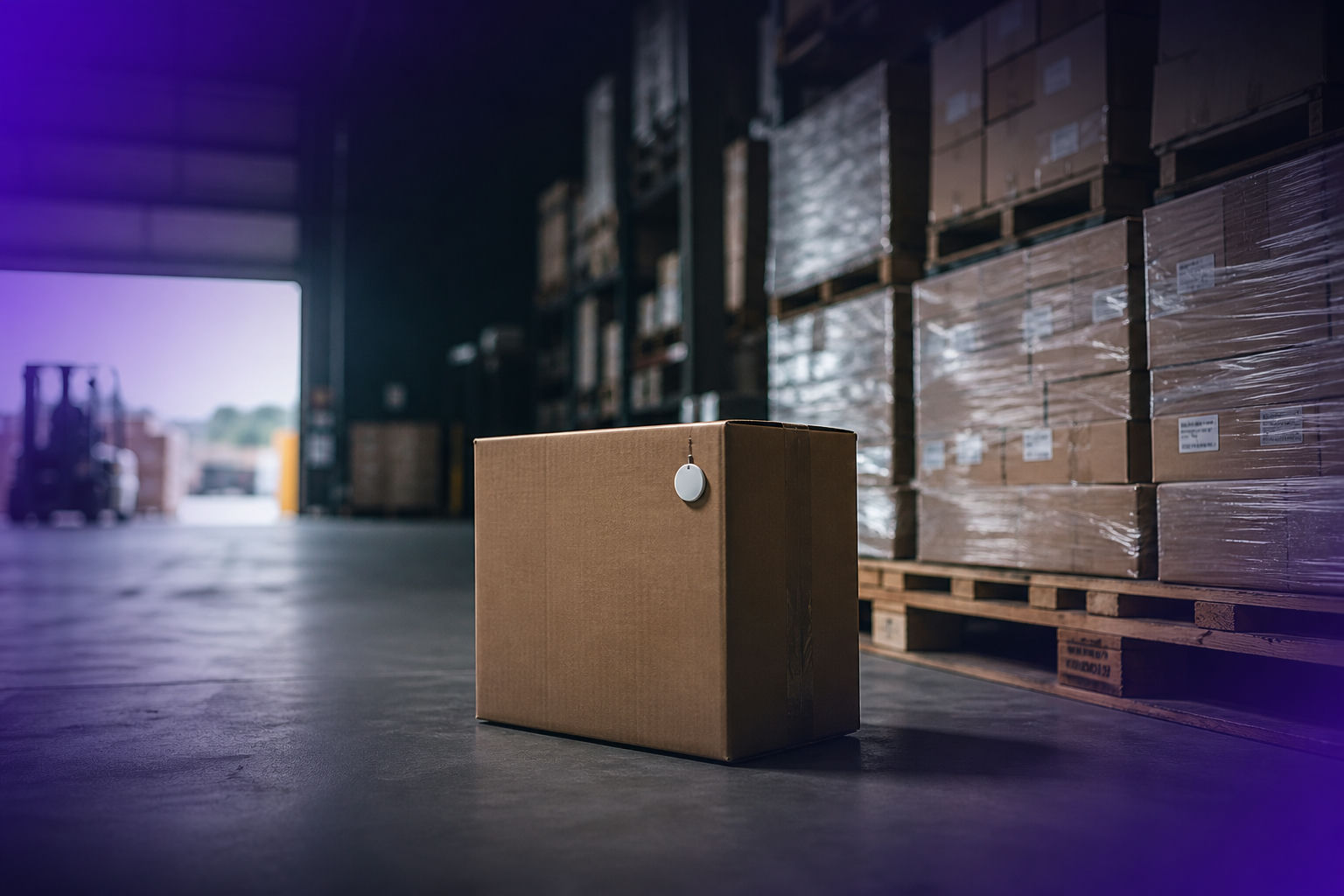
Beacon applications in the supply chain are strongest where location changes, condition readings, or proximity events move faster than manual scans can keep up. As of 2026, beacon technology has touched many parts of retail, logistics, healthcare, construction, and indoor navigation, but the common operational thread is simple: a signal has to become a decision early enough to matter.
Warehouses and vehicles
A warehouse beacon deployment often starts with the places where errors are frequent and expensive: dock doors, staging lanes, trailers, back rooms, cages, and returns areas.
In a warehouse or transport flow, BLE beacons can help answer:
- Is this asset in the right area?
- Did this shipment enter the correct vehicle?
- Is this reusable container still in the loop or sitting idle?
- Did a product pass a fixed read point without a matching process event?
- Has a temperature-sensitive item stayed too long outside a controlled zone?
The misload example shows why this is useful. The system does not need a worker to interpret every signal manually; it can turn proximity into a specific prompt at the moment of loading.
Stores and customer-facing spaces
A store beacon system often uses proximity for navigation, product finding, or local engagement. Sephora implemented a BLE beacon solution to deliver content related to a shopper's proximity when a shopper used the Sephora app on an Apple iPhone, as described in coverage of BLE beacon use in retail stores.
Target also integrated Bluetooth beacon technology into LED lighting with location sensors in stores to track customer movement and guide shoppers to products. That indoor location use shows why BLE became attractive in large buildings where satellite-based location is the wrong tool.
Reusable assets and construction materials
Reusable asset tracking is a practical fit because returnable containers, crates, pallets, trays, and roll cages often disappear into gray areas between facilities. Altrad Group, a French construction equipment manufacturer, uses Bluetooth beacons for real-time tracking of scaffolding products, according to the same beacon reference that documents industrial and retail uses.
For loop owners, the problem is rarely that every asset is gone forever. More often, the asset is delayed, idle, imbalanced, or sitting with the wrong party. Item-level visibility helps separate true loss from late return or poor repositioning.
Whole-area coverage depends on infrastructure
Area coverage becomes a design question when goods need visibility beyond one door or one room. A BLE mesh approach has been used to expand a low-energy Bluetooth network throughout an entire area, with devices connecting automatically and lasting years on a single battery, as reported in TechCrunch coverage of low-energy Bluetooth mesh beacons.
That fact should keep expectations grounded. A beacon is part of a networked operating model, and the business value appears when the signal can be heard and interpreted, then tied to a decision before the next handoff.
What to consider when deploying a beacon Bluetooth system
Beacon deployment planning should start with the decision that must get faster, not with the tag itself. Once the use cases are clear, the practical question is where a beacon Bluetooth system can create proof first.
Start with the decision point
A decision point is the moment where better data changes the action. In a cold-chain flow, that might be receiving. In a reusable-asset loop, it might be dispatch, return, cleaning, or dwell control.
Good first deployments tend to have a narrow operational question:
- Which containers are sitting too long at a carrier handoff?
- Which pallets entered the wrong staging area?
- Which chilled products experienced a condition exception before putaway?
- Which returnable assets are delayed rather than missing?
- Which trailer, room, or zone produced the repeated deviation?
Plan the receiving infrastructure
Receiver infrastructure decides whether the signal becomes a record. In 2026, research presented a computational framework combining beacon and blockchain technologies for secure, accessible indoor navigation, where beacons provided precise location information and blockchain supported secure, transparent recording of interactions through [BLE-based indoor navigation with secure data recording](https://link.In 2026, research presented a computational framework combining beacon and blockchain technologies for secure, accessible indoor navigation, where beacons provided precise location information and blockchain supported secure, transparent recording of interactions through BLE-based indoor navigation with secure data recording.com/article/10.1007/s42979-026-05236-6).
A supply-chain system does not need to copy that architecture to learn from the principle. The read event must be trusted enough to support action, and the data model must connect the physical read to the operational system where teams make decisions.
Treat cost claims carefully
Cost structure can make BLE attractive, but it should be judged against the full workflow. IEEE Spectrum reported that Apptricity estimated its Bluetooth beacons were 90 percent cheaper than LTE or satellite tags because they did not require a subscription to an established network, in an article on Bluetooth signals sent over long distances.
That figure does not mean every deployment is cheap or simple. The real cost includes receivers, integration, exception handling, analytics, maintenance, training, and the operational changes needed when the system flags a problem.
Choose data integration before scale
Data integration is where many beacon projects become useful or stall. A location read that lives in a separate dashboard may be interesting, but it may not change receiving, replenishment, quality release, or loss prevention.
Before scaling, define how the beacon record feeds:
- Inventory availability and inventory accuracy.
- Quality release or hold workflows.
- Shipment verification and receiving exceptions.
- Reusable-asset return and dwell reporting.
- Alerts tied to roles, not generic notification lists.
Wiliot is a Physical AI company that gives organizations continuous, scan-free visibility into the location and condition of every item in their supply chain. Battery-free IoT Pixels capture that data, and the Wiliot Physical AI Platform refines it into actionable insights, predicting problems like shrink and mis-ships, plus spoilage, and recommending the next move.
Next steps: using beacon data for operational intelligence
Beacon data for operational intelligence is useful only when identity, place, time, and condition turn into actions that teams can trust. Data collected after the decision point may explain what went wrong, but data delivered before the next handoff can change the outcome.
Apply the signal before the handoff
For temperature-sensitive goods, that might mean holding a product before it reaches the shelf. For reusable assets, it might mean finding dwell or delay, including imbalance, before the loop owner buys more containers. For inventory operations, it might mean reconciling physical products with system records without waiting for another manual scan.
Physical AI builds on that same operational need by reading the physical world continuously at item level, giving operators visibility in the gaps between manual scans and fixed read points. Teams exploring connected products and continuous temperature monitoring should begin with one decision clock: the moment when a signal can still change the outcome.
Frequently asked questions
How do I use a Bluetooth Low Energy beacon to track temperature deviations?
A Bluetooth Low Energy beacon tracks temperature deviations by broadcasting an identifier, and when paired with condition sensing, the system associates that identity with temperature status, time, and location context. The useful output is an exception record that tells a team which item or container may need inspection, hold, or rerouting. Source: Wiliot Temperature Monitoring
What are the advantages of BLE asset tracking in a warehouse?
BLE asset tracking is useful in warehouses because it works well indoors with low energy use and can turn proximity into an operational prompt. In a dock or staging area, that can help teams notice a misplaced package, pallet, tote, or reusable container before the next handoff makes the error harder to fix. Source: Wiliot Inventory Intelligence
Can I use Bluetooth beacons to track my products through my entire supply chain?
Bluetooth beacons can support supply-chain visibility when there is enough receiving infrastructure across the areas where the products move. The beacon provides identity and proximity data, while the broader platform and read points determine how much of the journey becomes visible from dispatch to receiving, storage, and replenishment. Source: Wiliot Physical AI platform
What is the difference between a Bluetooth beacon and other tracking tags like RFID?
A Bluetooth beacon broadcasts a BLE signal that nearby receivers can hear and interpret for proximity, location context, and sometimes condition data. Other tag types use different read methods and infrastructure. In practice, the right tag depends on the decision you need to make, where you need reads, and what condition data matters. Source: Wiliot IoT Pixels
How difficult is it to get started with a beacon Bluetooth tracking system?
Getting started is easiest when the first deployment is tied to one operational decision, such as receiving accuracy, shipment handoff, temperature exception handling, or reusable-container dwell. Hearing a beacon is usually the simpler part. The harder part is connecting the read to a trusted workflow that tells someone what to do next. Source: Wiliot Automated Receiving
Sources
Every reference cited on this page, in the order Wiliot evidence, related articles, then outside research.
- 1.continuous temperature monitoring (wiliot.com)
- 2.Wiliot Inventory Intelligence (wiliot.com)
- 3.Bluetooth beacons broadcast an identifier to nearby portable electronic devices (en.wikipedia.org)
- 4.What is a beacon Bluetooth signal? (kkkcdzmhnnqevxhexzpo.supabase.co)
- 5.Bluetooth Low Energy specification history (en.wikipedia.org)
- 6.Bluetooth beacons used to handle package misloads (supplychainbrain.com)
- 7.How BLE beacons provide location and condition data (kkkcdzmhnnqevxhexzpo.supabase.co)
- 8.BLE beacon use in retail stores (supplychainbrain.com)
- 9.low-energy Bluetooth mesh beacons (techcrunch.com)
- 10.BLE-based indoor navigation with secure data recording (link.springer.com)