.svg)

Short answer
Bluetooth beacons assign ownership when product condition changes in transit by creating a continuous record of product identity, location, and condition. They help teams identify who controlled the case, where it was, and when an excursion began or ended, bridging the information gaps that typically occur between formal scans or custody transfers in cold chain operations. Source: Wiliot IoT Pixels
Bluetooth beacons are small, low-power transmitters that broadcast signals using Bluetooth Low Energy (BLE) to nearby receiving devices. They enable location tracking and proximity marketing, and in supply chains they increasingly support condition monitoring by working with sensor technologies, because nearby phones, tablets, computers, or gateways can detect the signal and trigger an action, as early beacon deployments showed.
That definition gets more serious in cold chain operations. A spoiled case rarely fails at a clean ownership boundary; it usually fails after a scan, on a dock, during a carrier handoff, or while sitting in the wrong temperature zone with no person watching.
What are Bluetooth beacons?

Bluetooth beacons are proximity transmitters that let nearby receivers know a tagged asset, pallet, tote, case, or shipment is present. The same basic mechanism that helped stores detect a customer nearby also applies to supply chain assets, since beacons use BLE wireless signals to deliver information to devices in range, as Bluetooth beacon deployments in physical spaces have shown.
The beacon is the broadcaster
A Bluetooth beacon normally broadcasts a small radio message rather than opening a full two-way session every time. In a supply chain setting, that message helps a receiver identify that a specific physical product, asset, or shipment is nearby.
Useful beacon data can include:
- A unique identifier associated with a pallet, reusable container, case, or asset.
- A signal pattern that helps receiving infrastructure estimate proximity.
- A payload format that tells the receiving device how to interpret the broadcast.
- A sensor-linked record, when the beacon system is paired with condition sensing.
That distinction matters for handoffs. A barcode needs a person to scan it, but a beacon can be heard when the shipment passes through a receiving area, staging zone, trailer, store backroom, or cold room equipped with compatible receivers.
The receiver turns broadcasts into events
A receiving device can be a phone, tablet, computer, gateway, or fixed Bluetooth reader. The beacon does the simple job of broadcasting, while the receiving device records the encounter and passes the event into an application.
For cold chain teams, the value comes from joining three records that are too often separated:
- Identity, meaning which case, tote, pallet, or shipment was detected.
- Place, meaning which facility, dock, vehicle, or zone heard the broadcast.
- Condition, meaning the sensor reading associated with that product or asset.
Bluetooth beacons do not prove product quality by themselves. They create a continuous way to associate a physical item with location events, and condition sensors add the temperature or environment record that quality teams need.
Why the definition changes in supply chain work
Bluetooth beacons are often explained through consumer examples, but supply chain work puts a heavier burden on the record. Detecting that a device is present in a room is useful; proving who had custody when condition changed is the harder operational problem.
Item-level visibility between scans
The stronger supply chain use is item-level visibility across the gaps between formal scans. If a shipment is scanned out at one site and scanned in hours later at another, beacon reads can help fill in the custody path between those two events.
Foundational concepts: how beacons work
Once the handoff problem is clear, the mechanics matter. Bluetooth beacon systems depend on BLE radios, compact advertising messages, and signal interpretation, so the cold chain record is only as strong as the way those pieces are deployed.
Bluetooth low energy (BLE)
Bluetooth Low Energy is the radio foundation behind most beacon systems. BLE is a wireless personal area technology created for many device types and applications, and it has been useful indoors where GPS signals are weak or unreliable, as described in research on BLE beacon navigation.
BLE matters in warehouses and logistics sites because indoor movement is where the record usually gets thin. Trailers, dock doors, coolers, insulated rooms, metal racks, and backrooms all create environments where satellite positioning is not the main answer.
A typical cold chain BLE flow looks like this:
- A beacon or sensor tag is associated with a shipment, case, pallet, or returnable asset.
- The device broadcasts a BLE signal at set intervals.
- A receiver hears the broadcast when the asset is nearby.
- Software turns that signal into a time-stamped event.
- Condition data is joined to the item record for review or alerting.
Advertising packets and payloads
Advertising packets are the small messages broadcast by BLE devices. The packet does not need to carry the full story; it only needs enough information for the receiver to recognize the beacon and decide what to do next.
Beacon formats matter because they define what kind of payload can be sent. Google introduced Eddystone as an open-source, cross-platform Bluetooth LE beacon format, and its support for multiple frame types made payload design more flexible than single-purpose beacon formats, as Ars Technica reported when Eddystone launched.
The payload can support several practical supply chain jobs:
- Identifier payloads tell the system which item, asset, or shipment is nearby.
- Telemetry payloads can carry device state or sensor-related information when supported.
- URL or metadata-style payloads can point software toward a digital record.
- Format-specific payloads tell the receiver how to decode the signal.
Signal strength (RSSI) for proximity
RSSI, or received signal strength indication, is commonly used to estimate how close a receiver is to a beacon. Stronger signals usually suggest shorter distance, while weaker signals suggest greater distance, though real facilities make that relationship messy.
RSSI helps turn a broadcast into a proximity event:
- A receiver near a dock door may indicate a shipment is being loaded or unloaded.
- A receiver inside a cooler may indicate that product is inside the intended temperature zone.
- A receiver in a staging lane may indicate dwell before dispatch.
- A receiver in a store backroom may indicate that inventory arrived but has not moved to the floor.
The limitation is straightforward: RSSI is an estimate, not a tape measure. Metal, water, dense product, insulated packaging, human bodies, and reader placement can all change how a signal behaves.
Key terms in Bluetooth beacon technology
The handoff record gets confusing fast if everyone uses different language. These terms keep the cold chain custody problem tied to concrete mechanics rather than vague claims about visibility.
Core radio and beacon terms
- Bluetooth beacon: A small transmitter that broadcasts a BLE signal to nearby receiving devices.
- BLE: Bluetooth Low Energy, the low-power Bluetooth radio technology used by many beacon systems.
- Advertising packet: The short broadcast message sent by a BLE device.
- Payload: The data inside the advertising packet, such as an identifier or telemetry-related information.
- Receiver: A phone, tablet, gateway, access point, or fixed reader that hears the beacon signal.
- RSSI: A signal strength measure used to estimate proximity between a beacon and receiver.
Location and condition terms
- Proximity: A nearby relationship inferred from signal detection and strength.
- Handoff: A custody or process boundary, such as shipper to carrier, carrier to 3PL, or 3PL to receiver.
- Cold chain: A temperature-controlled movement and storage process for goods that need condition protection.
- Condition monitoring: Recording the state of a product or asset, commonly including temperature or other environmental signals.
- Excursion: A condition event that falls outside the desired range for the product.
- Dwell: Time spent in a location or zone, such as a dock, staging lane, trailer, or cooler.
Standards and formats
- iBeacon: Apple's beacon format, commonly associated with identifier-based proximity use.
- Eddystone: Google's open-source, cross-platform BLE beacon format, designed with multiple frame types.
- Frame type: A defined payload structure that tells receivers how to interpret a broadcast.
- Channel Sounding: A Bluetooth ranging capability introduced in Bluetooth Core Specification 6.0 in September 2024, with later 6.2 improvements in 2025 intended to strengthen ranging against spoofing. As of 2026, those specification changes show that Bluetooth location work has kept moving beyond basic signal-strength estimates.
Supply chain interpretation terms
- Chain of custody: The record of which party or facility had control of the product at each point.
- Item-level visibility: Visibility tied to a specific product, case, pallet, tote, or asset rather than only a shipment summary.
- Inventory traceability: The ability to connect inventory identity, movement, and status across locations.
- Physical-world data: Data captured from physical products and environments rather than entered manually after the fact.
These terms matter because the technology does not answer ownership by magic. It creates a record that quality, transportation, and receiving teams can use when a product's condition changes between formal system events.
How do Bluetooth beacons provide continuous condition data across cold chain handoffs?
Bluetooth beacons provide continuous condition data across cold chain handoffs by attaching identity and sensor-linked signals to the physical shipment, then letting receivers capture those signals as the shipment moves through facilities and vehicles, including storage zones and receiving points. The result is a better record of what happened between formal scans, where ownership questions usually get messy.
Attaching beacons to assets and shipments
Asset attachment is the starting point. The beacon must be associated with the thing whose movement or condition matters, which may be an individual package, pallet, reusable tote, roll cage, crate, or refrigerated shipment.
In a documented logistics example, a transmitter combining Bluetooth, Wi-Fi, GSM hotspots, and beacons could be attached to individual packages and assets to send real-time location and condition information through BLE protocols, and the same report said a major beer manufacturer used the device while shipping up to 900,000 pallets per month, with cold chain and e-commerce customers also adopting it for package-level visibility.
From shipment assumptions to item events
That kind of attachment changes the handoff record from a shipment-level assumption to a product-linked event stream. Instead of saying "the load left the facility," the system can say which tagged goods were heard near the dock, in the truck, at the cross-dock, or at the receiving location.
Integrating with sensors for condition data
Condition sensing is what makes the beacon useful for quality ownership rather than simple location awareness. The beacon-related identity tells the system which item is being observed, while the sensor record tells the system what happened to that item.
A practical cold chain record usually needs to answer four questions:
- Which product or asset was affected?
- Where was it when the condition changed?
- When did the excursion begin and end?
- Which party had custody or operational control at that time?
Bluetooth alone does not automatically answer all four. But when BLE broadcasts are tied to sensor readings and receiving infrastructure, the record starts to connect identity, place, time, and condition.
Real-time alerts during transit handoffs
Real-time alerts matter most at handoffs because that is where responsibility can blur. A case may leave the shipper in good condition, sit too long on a warm dock, move through a carrier facility, and arrive with a temperature record that nobody wants to own.
A beacon-enabled workflow can reduce that ambiguity:
- At dispatch, receivers confirm that the tagged shipment was present in the right outbound area.
- In transit or storage, gateway reads associate the shipment with a vehicle, lane, or facility.
- At receiving, the system compares expected goods with detected goods.
- If sensor data shows an excursion, teams review the time and location record around the handoff.
- If the product never entered the expected cold zone, the issue becomes operational rather than mysterious.
Continuous condition sensing is more useful than a single scan in that gap. A manual scan proves that a person interacted with an item at a moment; a beacon and sensor record can show what happened between those moments.
The case ownership problem
Case ownership is really an evidence problem. When quality changes in transit, each party often has only the records created inside its own operation, so the story breaks at the boundary.
A better handoff record contains:
- The last good condition reading before transfer.
- The first condition reading after transfer.
- The location events around the transfer.
- The dwell time in each zone.
- The item or asset identity tied to those events.
That record still needs human judgment. But it moves the conversation from blame to sequence, which gives quality teams, carriers, 3PLs, and receivers a better place to start.
Deployment considerations and limitations as of 2026
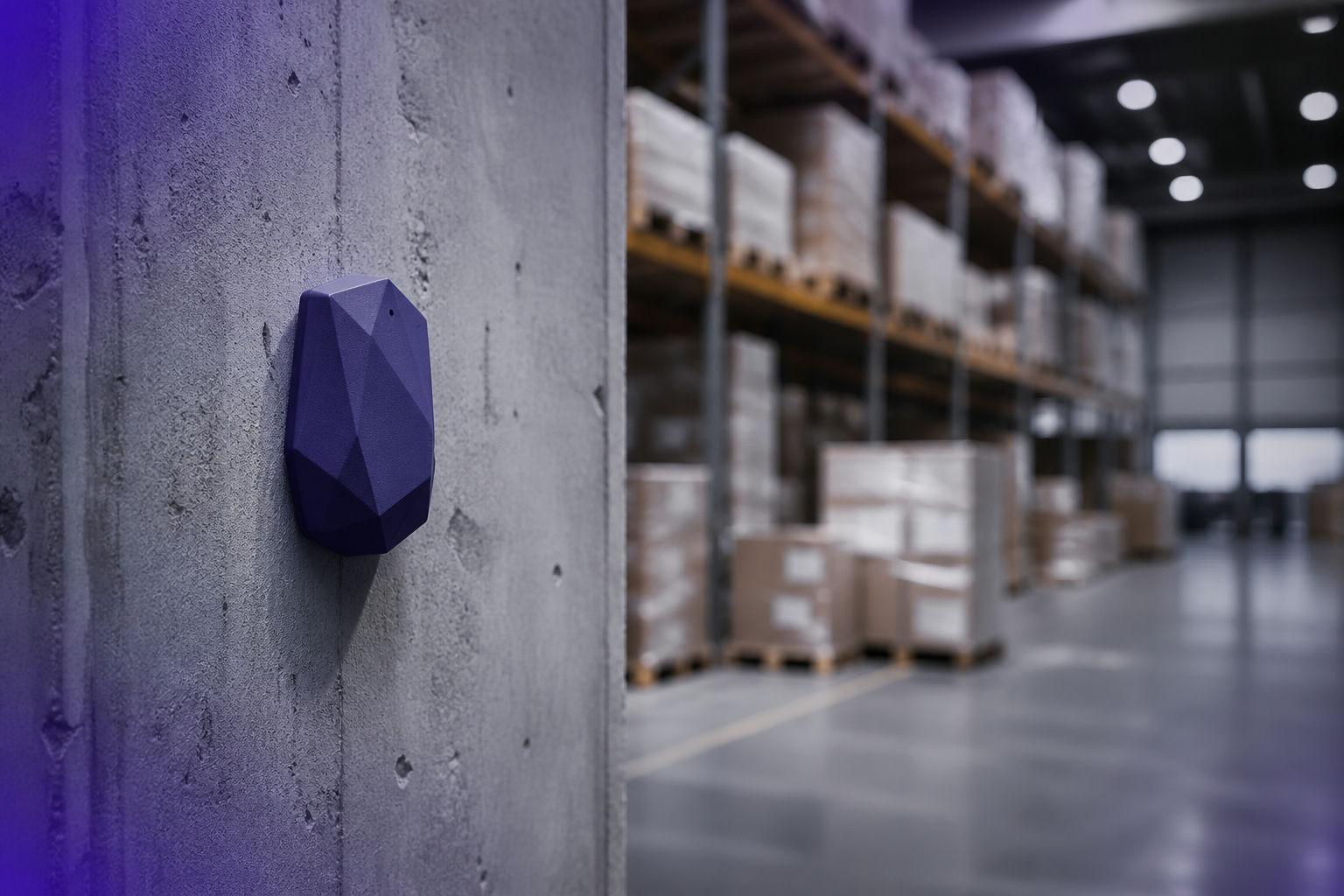
Bluetooth beacon deployment as of 2026 still comes down to operational design: coverage, receiver placement, environment, privacy discipline, and power strategy. The technology is useful only if it covers the handoff zones where condition and custody actually change.
Range and environmental factors
Range is not a single number in the real world. Bluetooth beacons can work well indoors and can track location from inches to about 50 meters in typical proximity contexts, but the same reporting also showed how beacon deployments raised privacy concerns when people could be tracked in public settings through nearby infrastructure.
In cold chain operations, the practical range question is tied to facility design:
- Can the receiver hear tagged goods inside insulated packaging?
- Are dock doors, coolers, staging lanes, and trailers covered?
- Does metal racking distort reads in certain aisles?
- Are reads frequent enough to establish dwell and handoff timing?
- Does the system distinguish "near the cooler" from "inside the cooler"?
Extreme Bluetooth range claims exist, including kilometer-scale records in specialized systems, but cold chain operators should treat those claims carefully. The useful question is whether the deployed infrastructure covers the handoff zones that decide product quality.
Privacy and data security
Privacy enters the conversation when beacon systems can be associated with people or consumer devices. Supply chain teams working with products, pallets, totes, or cases still need a clear data model, because device identity plus location and facility movement records can create sensitive operational trails.
For product condition workflows, the safer design principle is narrow and practical:
- Track physical goods and reusable assets, not people.
- Use identifiers that map to product records inside controlled systems.
- Limit access to custody, condition, and exception data by role.
- Keep the record focused on operational decisions, not broad behavioral monitoring.
This article does not cover legal or regulatory compliance. The operational point is simpler: beacon data should answer the custody and condition question without collecting more than the workflow needs.
The rise of battery-free beacons
Battery-free IoT Pixels change the maintenance equation because battery replacement becomes a serious barrier at item level. A pallet program may tolerate battery maintenance; a case-level or item-level program usually cannot.
Wiliot is a Physical AI company that gives organizations continuous, scan-free visibility into the location and condition of every item in their supply chain. Battery-free IoT Pixels capture that data, and the Wiliot Physical AI Platform refines it into actionable insights, predicting problems such as spoilage, mis-ships, and shrink, and recommending the next move.
Ambient energy and scale
Battery-free Bluetooth work has used ambient RF energy from Wi-Fi and Bluetooth signals, with techniques such as computing when RF energy is available and backscattering to send signals with minimal harvested power, as IEEE Spectrum described in its coverage of battery-free Bluetooth beacon technology.
That matters for cold chain handoffs because the business case improves when sensing can scale across far more goods without creating a per-tag battery-maintenance program. The goal is to make physical products that can be identified and monitored without depending on every operator to scan every case.
Putting this knowledge to work
Bluetooth beacon knowledge becomes useful when teams map the specific points where product identity, custody, and condition currently fall out of view. The technology choice should follow the operational gap, not the other way around.
Start with the handoff map
Handoff mapping should come before buying hardware. List the places where cold chain disputes happen, then identify which events are missing from the record.
A useful first map includes:
- Shipper release.
- Carrier pickup.
- Trailer or container dwell.
- Cross-dock transfer.
- 3PL receiving.
- Cold room entry.
- Store or DC receipt.
- Exception review after an excursion.
From there, compare the current manual record with the condition record you need. If the break happens between scans, the project is a strong candidate for scan-free sensing and item-level visibility.
Match the technology to the operational question
Operational fit matters more than beacon vocabulary. Enterprise tools in this category combine BLE beacons and sensors for location tracking, asset management, and environmental monitoring, as reflected in Gartner's description of enterprise IoT software for physical spaces.
Start with the problem that is already visible in the operation:
- If the issue is receiving variance, start with receiving events.
- If the issue is cold chain excursion ownership, start with temperature and custody evidence.
- If the issue is reusable asset imbalance, start with dwell, return flow, and location reads.
Build the record around condition evidence
For deeper comparison work, a guide to cold chain temperature monitoring records can help separate logger-style evidence, scan-based events, and continuous condition sensing. The right architecture depends on where the quality dispute begins.
For organizations moving toward item-level visibility, temperature monitoring should be evaluated as part of the broader handoff record, not as a standalone sensor project. The strongest deployments connect identity and movement with condition so the product record follows the goods.
The practical test is simple: when product condition changes in transit, can your team tell where it happened, when it happened, and who controlled the case at that point? If the answer is still a spreadsheet argument after the fact, the handoff record is the place to fix first.
Frequently asked questions
How do I use Bluetooth beacons to get continuous condition data across cold chain handoffs?
Bluetooth beacons broadcast identity and proximity signals that nearby receivers can capture as goods move through docks, vehicles, storage zones, and receiving points. When those beacon events are paired with condition sensors, the record can connect a product or asset to time, place, and temperature history across custody changes. Source: Wiliot Temperature Monitoring
What is the difference between iBeacon and Eddystone?
iBeacon is Apple's beacon format and is commonly associated with identifier-based proximity use. Eddystone was introduced by Google as an open-source, cross-platform Bluetooth LE beacon format, and it supported multiple frame types, which gave developers more payload options for beacon broadcasts. Source: Wiliot IoT Pixels
Can I use Bluetooth beacons without an internet connection?
Bluetooth beacons can broadcast locally without an internet connection, because the beacon signal is heard by nearby receiving devices over Bluetooth. Internet or network connectivity becomes important when the receiving device needs to send location or inventory events, including condition data, into cloud software for alerts and shared visibility. Source: Wiliot Physical AI platform
Are there Bluetooth beacons that do not need batteries?
Yes. Battery-free IoT Pixels are designed to capture physical-world data without a per-tag battery-maintenance program. That matters for item-level cold chain and reusable asset programs, where replacing or charging batteries across large numbers of tags can become operationally unrealistic. Source: Wiliot IoT Pixels
How has Bluetooth technology for location tracking improved as of 2026?
As of 2026, Bluetooth location work has moved beyond basic signal-strength methods through specification-level improvements such as Channel Sounding, which was introduced in Bluetooth Core Specification 6.0 in September 2024, followed by 6.2 updates in 2025 that strengthened ranging against spoofing. Source: Wiliot Physical AI platform
Sources
Every reference cited on this page, in the order Wiliot evidence, related articles, then outside research.
- 1.temperature monitoring (wiliot.com)
- 2.Wiliot IoT Pixels (wiliot.com)
- 3.What are Bluetooth beacons? (kkkcdzmhnnqevxhexzpo.supabase.co)
- 4.research on BLE beacon navigation (ieeexplore.ieee.org)
- 5.Ars Technica reported when Eddystone launched (arstechnica.com)
- 6.for package-level visibility (supplychainbrain.com)
- 7.Foundational concepts: how beacons work (kkkcdzmhnnqevxhexzpo.supabase.co)
- 8.battery-free Bluetooth beacon technology (spectrum.ieee.org)