.svg)

Short answer
Cold chain temperature monitoring tracks and documents the temperature of goods sensitive to environmental conditions, such as food and pharmaceuticals, throughout their entire supply chain journey. It provides a defensible temperature record that supports product quality and safety decisions, helps meet regulatory requirements, and minimizes waste by ensuring products remain within acceptable temperature ranges from origin to receipt. Source: Wiliot Temperature Monitoring
Cold chain temperature monitoring is the process of tracking and documenting the temperature of temperature-sensitive goods throughout their journey, supporting product quality and safety while helping teams meet regulations. Cold chain temperature monitoring matters because food, pharmaceuticals, and other environmentally sensitive products depend on controlled conditions during safe transportation through the cold chain.
What is cold chain temperature monitoring?
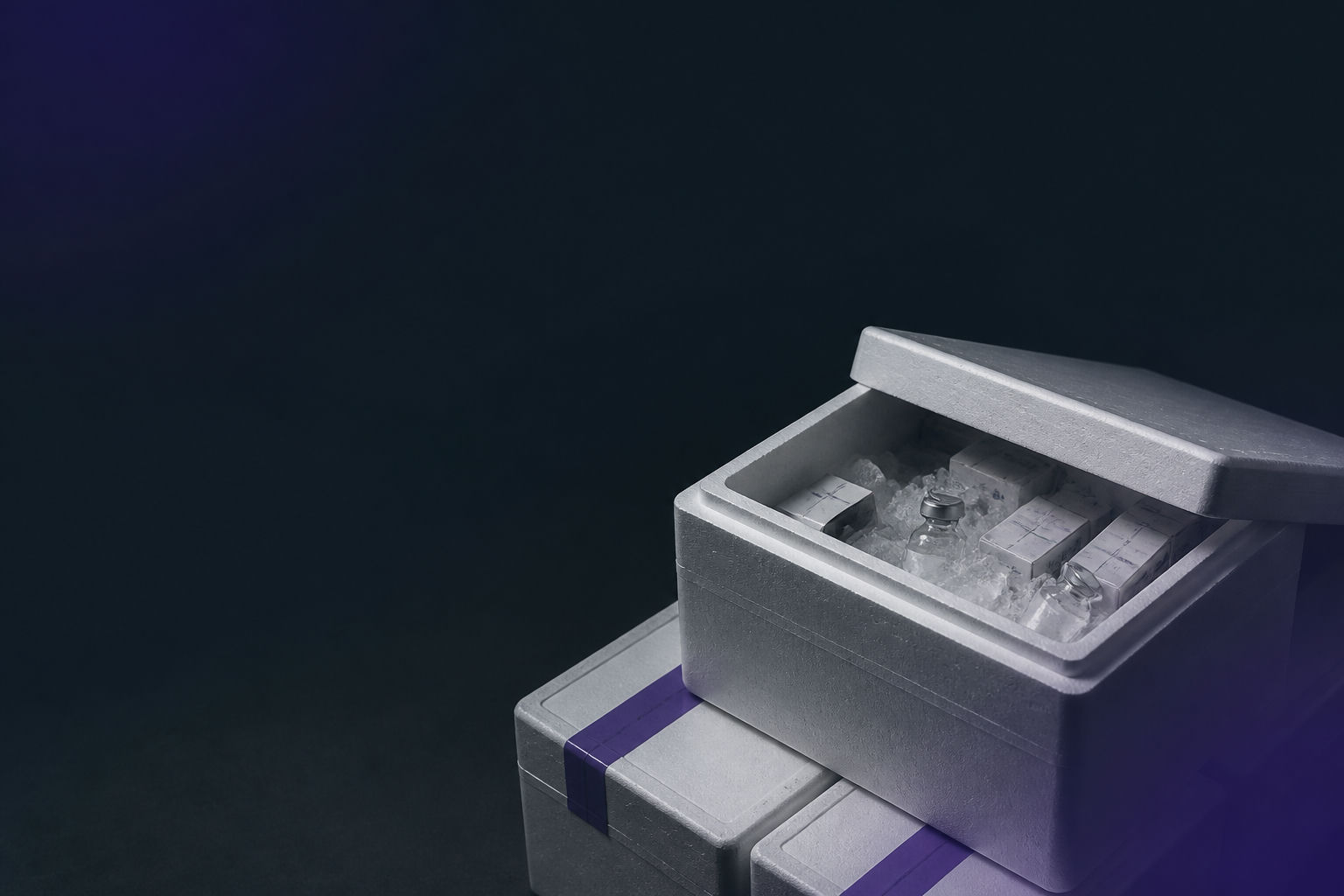
Cold chain temperature monitoring gives operators a defensible temperature record for products that can be damaged by heat, freezing, or unstable storage conditions. Typical temperature-sensitive products include dairy products, fresh food, horticultural products, blood, vaccines, and drugs, which is why the record has to stay close to the product rather than sit only at the facility level.
The record has to follow the product
Cold chain temperature monitoring is easiest to understand as a chain of evidence. A product may start at a production site, move through a warehouse, sit on a pallet or in a reusable container, ride in a trailer, cross a dock, and wait at the point of receipt. The monitoring record is meant to show what happened to that product through every handoff.
That evidence has to answer practical questions:
- Did the product remain inside its acceptable temperature range?
- Where in the journey did the temperature record change?
- How long did the change last?
- Which item, case, tote, pallet, or shipment was affected?
- Is the record strong enough for a quality, operations, or compliance review?
Temperature data is different from temperature evidence
A temperature reading tells you what a sensor saw at a point in time. Temperature evidence ties that reading to a product, place, time, and handling event, so a team can make a decision that will hold up later.
That distinction matters because cold chain teams rarely need data for its own sake. They need to know whether to accept, quarantine, release, investigate, or reject product. A reading without context leaves too much room for argument at the exact moment the operation needs clarity.
A useful cold chain record protects product quality and supports safety decisions by giving operators a shared version of what happened during the journey.
Why temperature evidence is critical in cold chain logistics
Cold chain temperature evidence explains why monitoring has to be treated as an operating control, not paperwork. The record helps a team decide whether sensitive product is still fit to move, sell, administer, or process.
Quality decisions need more than averages
Temperature excursions are operational events, but their consequences become quality decisions. A brief out-of-range event may mean something very different from a long exposure, and a heat event can raise different questions from a freezing event, depending on the product involved.
The vaccine example is blunt. WHO guidance states that adjuvant vaccines must not be exposed to freezing temperatures, so a monitoring record that only proves a refrigerator was generally cold is not enough. The record needs to show whether the product was exposed to a condition the product cannot tolerate.
The ideal record is a temperature history with a traceable link between a condition event and the physical goods that were exposed to it.
Cold chain teams therefore need evidence they can review after the fact. That evidence has to connect the condition event to the product that may have been exposed.
Failure becomes waste, delay, or dispute
Product loss is the visible part of a weak cold chain record. The harder problem is the uncertainty that follows. If a shipment arrives with incomplete or vague temperature data, teams may face three common outcomes:
- They may hold goods while they investigate.
- They may discard products they might have been able to release.
- They may accept risk because the data does not prove the exposure clearly enough.
Cold chain management problems can also create food waste. Inefficiencies in food cold chain management are linked to post-harvest food loss, which makes the monitoring record part of a larger operational discipline, rather than just a sensor purchase.
A useful temperature record reduces the room for dispute at the handoff. The shipper, carrier, receiver, and quality team can debate the decision, but they should not have to debate whether a temperature event happened.
Equipment also needs its own record
Equipment monitoring matters because a product record is only as strong as the environments the product passed through. As of 2026, WHO will require all vaccine refrigerators to have an Equipment Monitoring Device for vaccine storage, which reflects a broader principle: cold storage assets need condition evidence, not assumptions.
That does not mean every operation should monitor only equipment. A refrigerator, trailer, or cold room can be inside range while a specific product is mishandled during loading, unloading, staging, or dispatch. Equipment-level evidence and product-level evidence solve different parts of the same problem.
Key terms in cold chain monitoring
Cold chain monitoring terms sound simple until a product is on hold and every word in the record matters. The glossary below defines the terms that shape how teams review temperature risk, assign responsibility, and decide what happens next.
Temperature-sensitive products (TSPs)
Temperature-sensitive products are goods whose quality, safety, or usability depends on staying within defined temperature conditions. In this guide, the term covers products such as food, fresh produce, pharmaceuticals, vaccines, blood, and drugs.
The important operational point is that "temperature-sensitive" does not describe one industry. It describes a risk profile. If a product can be damaged by heat, freezing, or temperature instability during movement or storage, it belongs in the cold chain conversation.
Temperature excursion
A temperature excursion is a period when product or storage conditions move outside the accepted range for that product. The event can be short or long, obvious or hidden, and it may happen during storage, loading, transport, receipt, or temporary staging.
For quality teams, the excursion is only the start of the question. They also need to know the duration, severity, product identity, and point in the journey. Without those details, the team has a temperature exception, but not enough evidence to judge impact.
Data logger
A data logger is a monitoring device or record source used to capture temperature readings over time. In cold chain operations, the term often refers to a device assigned to a shipment, container, pallet, or storage location so the temperature history can be reviewed.
The value of a data logger depends on its context. A logger that records temperature but cannot be tied to the right product, shipment record, or handoff may create a file while leaving the operation with an evidence gap.
Equipment monitoring device (EMD)
An Equipment Monitoring Device records the condition of cold chain equipment such as a refrigerator or storage unit. The device supports equipment-level assurance by showing whether the asset used to hold product stayed inside required conditions.
EMDs are most useful when they are treated as part of a layered record. Equipment data can confirm that storage was stable, while product or item-level data can show what happened during the gaps between storage points.
What temperature monitoring solution is suitable for cold chain operations?
The suitable temperature monitoring solution for cold chain operations is the one that creates evidence at the level where decisions are made. If your team releases product by shipment, monitor the shipment. If risk occurs at tote, pallet, case, or item level, the record needs to get closer to that physical unit.
Start with the decision you need to defend
Solution fit begins with the quality decision, not the device catalog. A receiver who only needs proof that a full trailer stayed in range has a different evidence need from a vaccine operator, a grocery distributor, or a reusable container loop owner trying to distinguish delay from true loss.
A practical selection process starts with four questions:
- What product can be harmed by temperature change?
- Where is the highest-risk handoff or dwell point?
- Who decides whether product is accepted, held, or rejected?
- What record would make that decision defensible after the shipment is gone?
If the answer is "we need to know what happened to each physical unit," facility-level or trailer-level data will feel thin. If the answer is "we need a trip record for a shipment," a shipment-level logger may be enough.
Use connected monitoring where the journey is complex
Connected monitoring becomes more valuable as a route adds handoffs and dwell time under shared responsibility. Research on food cold chain monitoring describes RFID and wireless sensor networks as leading technologies in the field, which points to a practical reality: cold chain evidence improves when identification and sensing are connected to the movement of goods.
For cold chain operators, the suitable solution often includes a mix of records:
- Equipment records cover refrigerators, rooms, and other controlled storage points.
- Shipment records cover trailers, lanes, and carrier movements.
- Item-level visibility matters where product identity, condition, and handoff accountability matter.
- Exception alerts help when a team needs to act before a shipment completes.
- Historical records support claims, release decisions, audits, and process improvement.
The more fragmented the route, the more valuable it becomes to connect temperature records to the goods themselves. That is especially true in reusable asset loops, where a tote, crate, roll cage, or pallet can dwell in the wrong place long enough to create both product risk and asset imbalance.
Treat simple cards as narrow tools, not default answers
Temperature cards can look attractive because they are simple, but simplicity becomes a liability when the record has to support a decision. WHO no longer recommends Cold Chain Monitor cards for in-country use and says their use should be confined to international shipments where dry ice is involved.
That guidance is useful beyond vaccines because it shows the basic selection principle. A card may indicate exposure, but it does not necessarily give the time, place, duration, identity, and handoff context needed for modern cold chain operations.
A tool that signals exposure is not always the same as a record that can support a release, hold, rejection, or claim decision.
As of 2026, the market signal also points toward more connected evidence. The global cold chain temperature monitoring market was valued at USD 8.06 billion in 2025 and is projected to grow from USD 9.35 billion in 2026 to USD 30.65 billion by 2034, with North America holding a 36.8% share in 2025. Those figures do not prove a specific tool is right, but they do show that temperature evidence has moved from a niche control to a core operating capability.
Common challenges: the gap between having data and having evidence

Cold chain operations can collect plenty of temperature data and still lack the evidence needed to act quickly. The gap appears when the record is incomplete, disconnected from the product, or hard to interpret at the handoff.
Condition data can lose context
Condition data becomes weak when it is separated from product identity. A cold room reading may show that the room was fine, while a pallet sat outside the room during loading. A truck record may show the trailer average, while one container near a door experienced a different condition.
Cold chain systems can also monitor conditions beyond temperature, including humidity and lighting intensity, to prevent quality loss. This guide stays focused on temperature, but the larger lesson is the same: a condition signal becomes useful only when it is tied to the goods, place, time, and decision.
The evidence gap usually appears in ordinary work, not only in major failures.
The gap usually appears in ordinary work:
- A shipment arrives and the receiver has a temperature file, but not a clear link to each affected pallet.
- A reusable container is delayed, but the team cannot tell whether the product inside was exposed.
- A trailer record looks acceptable, but a staging delay is not captured.
- A quality team sees an alert, but the operational owner is unclear.
Manual handoffs create blind spots
Manual scans are useful, but they create snapshots. A scan can confirm that something was seen at a dock door, received into a warehouse, or moved to a staging area. It does not automatically prove what happened between those events.
That gap matters in cold chain work because temperature risk often appears between formal checkpoints. Goods can wait during loading, dwell in a yard, sit in a missed staging lane, or move through a handoff where no one captures the condition record.
Where continuous visibility fits
Wiliot is a Physical AI company that gives organizations continuous, scan-free visibility into the location and condition of every item in their supply chain. Battery-free IoT Pixels capture that data, and the Wiliot Physical AI Platform refines it into usable insights that predict problems like shrink, mis-ships, and spoilage and recommend the next move.
Item-level visibility changes the review
Item-level visibility helps close the cold chain evidence gap because the condition record can stay associated with the physical goods, rather than only with a room, truck, or shipment file. Quality judgment still matters, but the judgment starts from a stronger record.
A scan-free approach is especially useful where reusable assets and temperature-sensitive goods move together. If a tote, crate, tray, or pallet carries product through a managed loop, the operator needs to see both movement and condition. Otherwise, a delayed asset can look like a lost asset, and a product exposure may be discovered only after the fact.
For reusable asset loops, condition evidence and movement evidence need to stay connected to the same physical unit.
For teams evaluating BLE and related condition-sensing options, a deeper explanation of beacon-based product condition records is available in a guide to the BLE beacon for product condition.
How to close the evidence gap in your cold chain
A cold chain temperature monitoring program should be judged by the decisions it improves, especially accept, hold, reject, investigate, release, and claim resolution. The goal is not to collect more files. The goal is to create a record that connects condition and identity with place and time closely enough for teams to act without guessing.
The practical path is straightforward:
- Map the product journey from origin to receipt.
- Mark the handoffs where temperature evidence becomes weak.
- Decide whether the decision is made at equipment, shipment, pallet, case, tote, or item level.
- Match the monitoring record to that decision level.
- Review exceptions in a way that connects condition and identity with place and time.
The right solution is rarely the most complex tool by default. It is the monitoring record that gives your quality and operations teams enough proof to act when product is still moving, and enough evidence to defend the decision after the fact.
If you are comparing record types before choosing a system, the next useful step is to read Cold chain temperature monitoring: which record is right?. For teams ready to connect condition data to physical goods at item level, the temperature monitoring resource explains how continuous condition sensing supports cold chain visibility without relying on manual scans alone.
Frequently asked questions
What temperature monitoring solution is suitable for my cold chain operations?
Choose the solution that records temperature at the same level where your team makes release, hold, or rejection decisions. For simple shipment-level decisions, a shipment record may be enough. For complex networks with reusable containers, shared handoffs, or product-level risk, item-level visibility gives the team a stronger condition record tied to the physical goods. Source: Wiliot Temperature Monitoring
Why can't I just use simple temperature cards for my shipments?
Simple cards can indicate exposure, but they often do not provide enough context about time, duration, product identity, or handoff location. They are narrow tools, not a full evidence system. If your team needs to defend a quality decision after a shipment arrives, use a record that connects the condition event to the affected goods. Source: Wiliot Temperature Monitoring
What kind of products actually need cold chain monitoring?
Cold chain monitoring is used for products that can lose quality, safety, or usability when they are exposed to the wrong temperature. Common examples include fresh food, dairy, horticultural products, blood, vaccines, and drugs. The shared issue is sensitivity to temperature, not the industry label. Source: Wiliot Physical AI platform
How do I know if a temperature change has actually harmed my product?
A temperature change becomes a quality question when you know the product, the acceptable range, the length of exposure, and the severity of the event. The monitoring system should give your quality team enough evidence to compare the exposure against the product's handling rules and decide whether to release, hold, or reject it. Source: Wiliot Temperature Monitoring
Is the market for this technology growing?
Yes, adoption signals point toward more cold chain teams investing in connected temperature evidence rather than relying only on manual checks or isolated records. The reason is practical: operators need faster exception review and clearer handoff accountability, with better visibility into product condition across the journey. Source: Wiliot Physical AI platform
Sources
Every reference cited on this page, in the order Wiliot evidence, related articles, then outside research.
- 1.temperature monitoring (wiliot.com)
- 2.What is cold chain temperature monitoring? (kkkcdzmhnnqevxhexzpo.supabase.co)
- 3.dairy products, fresh food, horticultural products, blood, vaccines, and drugs (ieeexplore.ieee.org)
- 4.adjuvant vaccines must not be exposed to freezing temperatures (who.int)
- 5.Equipment Monitoring Device for vaccine storage (extranet.who.int)
- 6.USD 8.06 billion in 2025 and is projected to grow from USD 9.35 billion in 2026 to USD 30.65 billion by 2034 (straitsresearch.com)
- 7.Why temperature evidence is critical in cold chain logistics (kkkcdzmhnnqevxhexzpo.supabase.co)