.svg)
Short answer
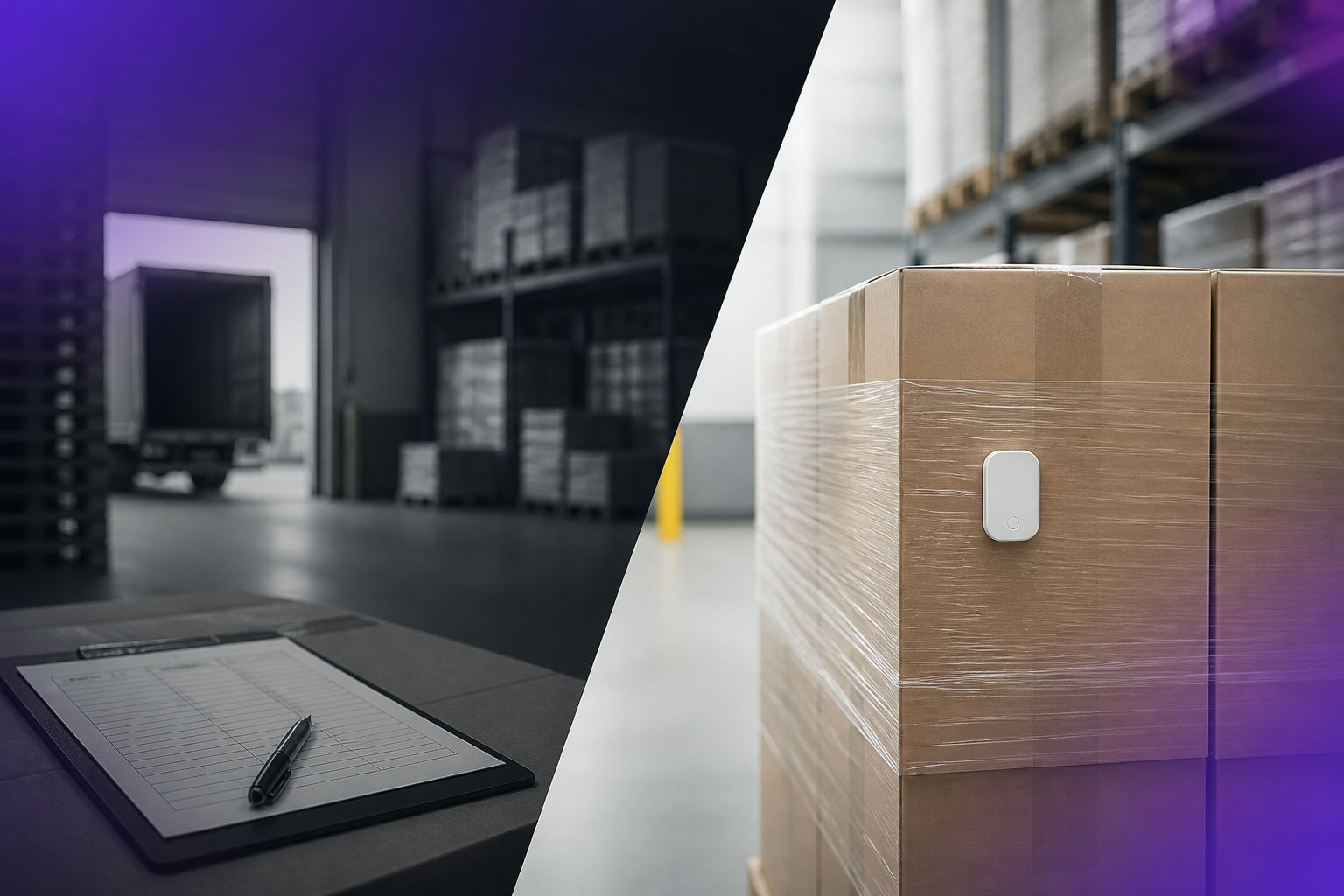
Bluetooth Low Energy (BLE) beacons offer real-time visibility into temperature, humidity, and location, transmitting continuous data to enable immediate action on cold chain deviations. Traditional data loggers, by contrast, primarily provide post-trip records, useful for documenting past events but less effective for intervention during transit. Choosing between them depends on whether your operation needs to act on deviations while products are still in the cold chain or if a delayed record is sufficient. Source: Wiliot IoT Pixels
A spoiled refrigerated load usually leaves one argument: when did temperature drift, and could anyone have acted while the product was still in the right place? The best Bluetooth Low Energy (BLE) beacons for cold chain monitoring offer continuous, battery-free data collection and real-time visibility into temperature, humidity, and location, often outperforming traditional RFID or battery-powered solutions in specific use cases because BLE beacons transmit data to apps on Bluetooth-enabled devices at adjustable intervals.
The verdict: BLE beacons vs. data loggers for cold chain monitoring
Cold chain monitoring comes down to the evidence your team needs. Some operations need only a post-trip record. Others need live condition evidence while someone can still reroute, inspect, quarantine, or release product. Some Real-Time Location System (RTLS) technologies include ultrawideband beacons, BLE beacons, and traditional active and passive RFID, while the same RTLS category is also used for gathering temperature data for cold chain visibility.
The short answer: pick BLE beacons when temperature deviations need action during transport, receiving, storage, or handoff. Pick traditional data loggers only when a delayed record is enough.
The short answer for operators
For a cold chain quality leader, bluetooth low energy beacons win when the job is to catch a deviation while product is still recoverable. They fit perishable food, temperature-sensitive reusable containers, and high-volume refrigerated flows where waiting can mean spoilage, rework, disputed handoffs, or a shipment that cannot be confidently released.
Traditional data loggers still fit simple, controlled lanes when the record is reviewed after shipment. They can work as a trip archive, but they are weaker when teams need to know where the excursion happened and what else was nearby.
Why the wrong choice costs time
The wrong monitoring choice usually creates investigation work. A logger can prove that something happened, but if the product has arrived, the operational window has narrowed. A beacon-centered model gives teams real-time visibility, so evidence can support exception handling instead of post-trip review alone.
For cold chain condition monitoring, BLE beacons are stronger when temperature data must be read with location and timing. Data loggers are acceptable when your team only needs a record, not an alert.
How we're judging: the 4 criteria for cold chain evidence
The comparison needs standards that reflect how cold chain teams work, not a vendor feature checklist. Bluetooth Low Energy is a wireless communication technology designed for power-constrained IoT applications, which is why BLE fits Internet of Things uses where small devices must keep reporting without heavy infrastructure at every touchpoint.
The four criteria are:
- Alert latency: Does the system surface a temperature deviation while someone can still act, or only after the shipment is retrieved and reviewed?
- Condition plus location context: Does the record connect temperature evidence to where the product was, which area it passed through, or which handoff was involved?
- Item-level visibility: Can the evidence sit close enough to the physical goods to narrow the investigation from "a load had a problem" to "these items or containers were exposed"?
- Operational burden: Does the system add battery maintenance, manual scanning, retrieval work, or exception chasing that the team cannot sustain at scale?
These criteria matter because cold chain failures rarely fail neatly. A temperature deviation becomes useful evidence when it can be tied closely enough to the right product, time, and place to guide a release, quarantine, reroute, or claim decision.
Comparison matrix: bluetooth low energy beacons vs. traditional data loggers
Measured against those standards, each option is an evidence model. One helps teams act during the shipment. The other is strongest after the shipment is over.
| Criteria | Bluetooth Low Energy beacons | Traditional data loggers | Winner |
|---|---|---|---|
| Alert latency | Designed for live or near-live reads when connected to the right infrastructure | Usually strongest as a record reviewed after retrieval | BLE beacons |
| Condition plus location context | Can connect condition data with presence and movement within an area context | Typically emphasizes the temperature record itself | BLE beacons |
| Item-level visibility | Better suited to item, tote, crate, pallet, or shipment-level evidence | Often applied at shipment, box, or lane level | BLE beacons |
| Operational burden | Low-power design reduces maintenance pressure, with battery-free options in ambient IoT systems | Simple to place, but retrieval and review can create manual work | Depends on process |
| Evidence after the fact | Useful if data has been captured and associated with the right product | Strong for post-trip documentation | Data loggers |
If your team values intervention, BLE beacons are ahead. If your team values a simple archive and can live with delayed review, traditional data loggers remain defensible.
Option 1: the case for Bluetooth Low Energy (BLE) beacons
BLE beacons make the strongest case when condition evidence must travel with the product, container, or pallet while the cold chain is still active. BLE is optimized for short-range communication, typically less than 50 meters, and has very low power consumption, allowing battery-operated devices to function for years without replacement. The same research notes that BLE operates in the heavily used 2.4 GHz band and can face Wi-Fi interference or unreliable detection in some settings, so the short-range and interference trade-offs need to be designed into the cold chain evidence model.
Frequently asked questions
How does a Bluetooth Low Energy beacon track temperature deviations?
A Bluetooth Low Energy beacon tracks temperature deviations by broadcasting condition data from a tagged product, container, pallet, or area to a Bluetooth-enabled reader. In cold chain monitoring, the useful record combines temperature with timing and location context, so the team can see when a deviation happened and which physical goods were exposed. Source: Wiliot IoT Pixels
When comparing RFID vs Bluetooth, which is better for real-time cold chain visibility?
Bluetooth is usually the better fit when the priority is real-time cold chain condition visibility between fixed read points, especially when temperature evidence needs to be tied to movement or dwell. RFID can still be useful at defined portals or handoffs, but BLE beacons are better aligned with live condition monitoring across the flow of goods. Source: Wiliot Temperature Monitoring
What makes a BLE beacon suitable for item-level cold chain monitoring?
A BLE beacon is suitable for item-level cold chain monitoring when it is low power, small enough to sit close to the physical goods, and able to communicate condition data through existing Bluetooth infrastructure. For cold chain use, the beacon also needs to support a product-level or container-level identity so temperature evidence does not get separated from the item record. Source: Wiliot IoT Pixels
What are the main disadvantages of using BLE for condition monitoring?
The main disadvantages are range planning and interference risk, along with missed reads if the receiving infrastructure is poorly placed. BLE operates in busy radio environments, so cold chain teams should treat beacon monitoring as a system design problem that includes reader coverage and exception logic as well as operational workflow. Source: Wiliot Physical AI platform
Sources
Every reference cited on this page, in the order Wiliot evidence, related articles, then outside research.
- 1.temperature monitoring built around item-level condition visibility (wiliot.com)
- 2.Wiliot IoT Pixels (wiliot.com)
- 3.BLE beacons transmit data to apps on Bluetooth-enabled devices (nature.com)
- 4.The verdict: BLE beacons vs. data loggers for cold chain monitoring (kkkcdzmhnnqevxhexzpo.supabase.co)
- 5.gathering temperature data for cold chain visibility (logisticsmgmt.com)
- 6.short-range and interference trade-offs (arxiv.org)
- 7.near-real-time visibility of physical inventory (supplychainbrain.com)
- 8.How we're judging: the 4 criteria for cold chain evidence (kkkcdzmhnnqevxhexzpo.supabase.co)