.svg)

Short answer
IoT-based tracking is the strongest approach for managing automotive returnable packaging. It transforms a blind loop of containers, racks, pallets, and totes into a measured operating system by providing a dependable digital record for each asset. This improves item-level visibility, reduces losses, and makes inventory and logistics decisions less dependent on late scans or spreadsheet cleanup. Source: Wiliot Reusable Asset Tracking
Verdict: 4.5 / 5. IoT-based tracking is the strongest approach for managing automotive returnable packaging because it turns a blind loop of containers, racks, pallets, and totes into a measured operating system.
Automotive returnable packaging breaks down when assets disappear between suppliers, plants, transport hubs, 3PL facilities, and customer locations. Strong IoT-based systems close that gap with a dependable digital record for each asset, improving item-level visibility, reducing losses, and making inventory and logistics decisions less dependent on late scans or spreadsheet cleanup. That matters because inefficient returnable transport item flows in automotive just-in-time supply chains have been tied to [higher costs, service failures, and negative environmental impacts](https://www.Inefficient management of Returnable Transport Items (RTIs) in automotive Just-in-Time (JIT) supply chains has been tied to higher costs, service failures, and negative environmental impacts.com/science/article/abs/pii/S0925527316000591).
Why IoT-Based Tracking Is Key for Automotive Returnable Packaging
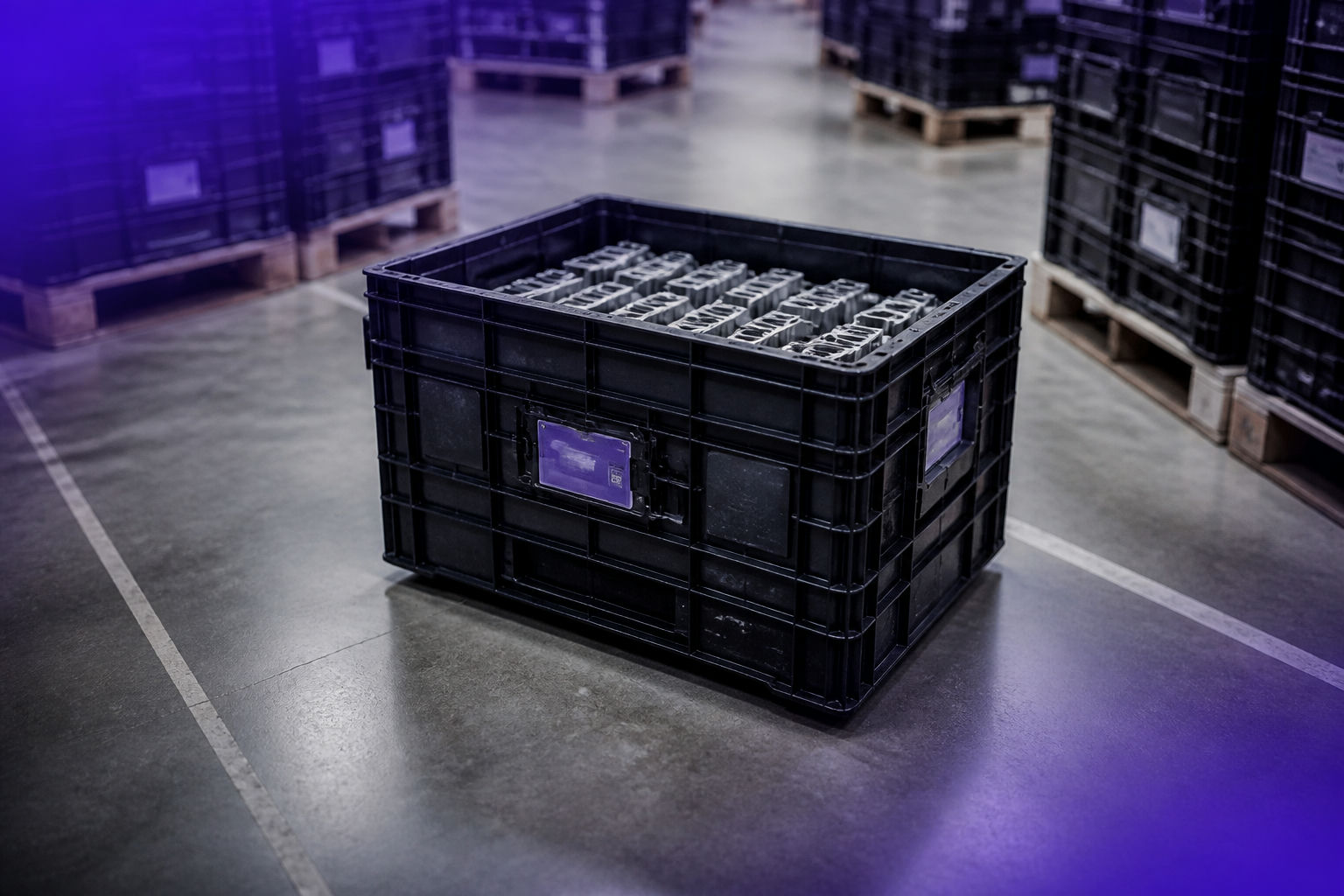
The short answer: visibility has to follow the asset
The practical reason to choose IoT-based tracking is simple: returnable packaging keeps moving after the last scan. A rack may leave a supplier, sit at a transport hub, get staged at a plant, or drift into the wrong pool while the control system still shows only the last handoff. As of 2026, that blind stretch is where losses, long dwell, false shortages, and blame cycles build.
Our one-line take
For teams expediting empty containers, buying buffer stock, or arguing over missing racks, item-level visibility is the difference between managing a loop and guessing at it. The score is not perfect because implementation still takes process work, data cleanup, and integration discipline. Even so, the payoff is strong enough to put IoT-based tracking on the default shortlist for complex automotive returnable packaging loops.
Use IoT-based returnable packaging tracking when the cost of not knowing where assets are has become higher than the cost of instrumenting the loop.
Overall Scorecard: How We Rated This Approach
The verdict comes from one operating question: does the system reduce the blind spots that make returnable packaging expensive to manage?
| Evaluation dimension | Score | Why it matters |
|---|---|---|
| Asset visibility | 5.0 / 5 | Best fit when assets cross many sites and ownership boundaries. |
| Loss prevention | 4.5 / 5 | Strong where shrinkage is driven by blind handoffs and poor return discipline. |
| Ease of deployment | 3.5 / 5 | Requires asset onboarding, location mapping, and workflow changes. |
| Integration value | 4.0 / 5 | Highest when connected to WMS, ERP, or transport systems. |
| ROI clarity | 4.5 / 5 | Works best when loss, dwell, labor, and imbalance costs are measurable. |
The strongest scores come from loop problems: hidden dwell, unbalanced pools, and manual counting. The weaker score is deployment effort, because tracking is useful only when the physical asset, digital record, and operating process line up.
The Core Challenge: Losses, Dwell, and Imbalances
The scorecard only makes sense once the core problem is clear: most packaging failures are visibility failures before they become cost failures.
Automotive loops are built around reusable assets
Automotive parts logistics commonly use returnable plastic or metal packages, including pallets, containers, and racks, according to research on returnable packages in automotive parts logistics. That makes the asset pool valuable, distributed, and easy to misread. A rack idle at a supplier may look like a plant shortage, while a tote in transit may look like a ledger loss.
Loss is often delay wearing a different name
The hard part is separating true loss from delay, dwell, imbalance, or poor scan discipline. In a manual or portal-only process, the system may know an asset left one site, but not whether it was unloaded, staged, held, damaged, returned late, or mixed into the wrong pool.
That ambiguity creates bad decisions:
- Companies buy extra returnable assets because the pool looks smaller than it is.
- Teams send empty-mile recovery moves to chase assets already on their way back.
- Plants expedite parts because packaging availability looks worse than the actual condition.
- Suppliers, carriers, or plants get blamed without a shared custody record.
JIT pressure makes the problem sharper
In automotive just-in-time operations, packaging is part of the production rhythm. When the empty rack or container is missing, part flow can fail even if the part is available, so returnable packaging tracking belongs with inventory accuracy, production continuity, and transport performance.
System Capabilities: A Feature-by-Feature Assessment
Once the problem is a visibility gap, the needed capabilities are clear: the asset needs an identity, the loop needs reliable capture points or scan-free sensing, and operators need data before the shortage hits production.
Asset visibility and real-time location tracking
The baseline capability is real-time location tracking across the loop. RFID and Bluetooth Low Energy (BLE) technologies, supported by real-time supply chain visibility solutions, are used for end-to-end tracking of Returnable Transport Items (RTIs) across warehouses, transport hubs, and customer locations.
The same reporting describes digital identity as a single source of truth while citing a large logistics company managing over 100,000 returnable assets across multiple sites that reduced shrinkage, lowered manual workload through automated data capture, and balanced distribution during peak demand through real-time tracking and automated data capture.
That is the strongest evidence for this category. The system gives teams a shared operating picture, so the pool can be managed by location, cycle status, owner, lane, and exception instead of by month-end reconciliation.
Automated data capture and digital identity
The next requirement is **digital identity for physical products**. Each asset needs an identity that persists through trips, handling events, cleaning, staging, and returns, because a pooled rack becomes anonymous once it leaves the last controlled point without a dependable record.
Automated capture makes that identity useful in daily operations. Manual scans can work at narrow checkpoints, but they struggle when labor is tight, assets move in batches, or exceptions happen away from a dock door. For readers comparing sensor and tagging options across reusable loops, the same principles apply to pallets, trays, totes, crates, and racks, which is why a broader reusable asset tracking guide is useful when scoping the operating model.
Analytics for dwell time and bottleneck analysis
After identity and capture, dwell-time analytics turns location history into action. Seeing that an asset is at a plant is helpful. Seeing that it has exceeded expected dwell by lane, supplier, or process step gives operations a reason to intervene.
This is where the review score rises. The best systems show whether shortages come from too few assets, too much idle time, poor returns, or bad distribution. Treating those as one generic shortage usually leads to overspending.
Pros and Cons of IoT-Based Tracking Systems

The same visibility that makes IoT-based tracking valuable also exposes the work required to make it stick. The upside is stronger loop control. The trade-off is that the process has to be ready to use the data.
Pros
The main benefit is control without constant manual checking. As of 2026, IoT-based systems fit returnable packaging loops because they reduce dependence on people finding, scanning, and reconciling assets after the fact.
- Item-level records make it easier to see where assets exit the expected loop.
- Automated data capture reduces repeated cycle counts and spreadsheet reconciliation.
- Location and dwell data help move assets toward the sites that need them.
- A shared digital identity improves forecasting because planners work from a common record.
- Teams can distinguish missing assets from delayed, idle, or misplaced assets.
For companies evaluating Physical AI, the Wiliot Physical AI Platform delivers continuous, item-level, scan-free reading of physical goods through battery-free IoT Pixels. That fit matters in reusable pools because a per-tag battery maintenance program would add another operating burden. The test is whether continuous physical-world data can feed the workflows that govern replenishment, transport, and returns.
Cons
The trade-offs are real. A tracking system can expose problems quickly, but it does not fix asset ownership, lane discipline, master data, or exception handling by itself.
- Assets need identities, locations need structure, and workflows need clear event logic.
- WMS, ERP, transport, and yard processes have to consume the data instead of treating it as a side dashboard.
- Operators need to trust the record and act on exceptions before the weekly review.
- The spend often comes before the full savings are visible, especially in loops with poor baseline data.
That last point is where many programs get uncomfortable. If the business cannot estimate shrinkage, labor hours, dwell penalties, or emergency replenishment costs, ROI may still be positive, but it will be harder to prove.
Pricing and ROI Considerations for Tracking Technology
The business case follows the same operating reality: if the loop is blind, savings have to come from avoided loss, less manual work, better pool balance, and fewer emergency moves.
The pricing model: budget for the whole loop
Public, like-for-like pricing for returnable packaging tracking systems is not available in the supplied evidence, so a responsible pricing review should not invent per-tag, per-site, or software subscription numbers. In 2026, budget for a loop-level investment with several cost buckets.
| Cost tier | What it includes | Concrete number supported by evidence |
|---|---|---|
| Asset baseline | Packaging cost, reuse assumptions, pool size, replacement rate | A packaging reuse benchmark from Yangfeng Automotive Interiors estimated the costs to reuse the packages as $0.60 to $1.10 per reuse. |
| Tracking deployment | Asset identity, tags or IoT Pixels, location setup, onboarding labor | No public number supported in the supplied evidence. |
| Platform and integration | Visibility software, WMS or ERP connection, alerts, reporting | No public number supported in the supplied evidence. |
| Operating program | Exception handling, recovery moves, governance, data reviews | No public number supported in the supplied evidence. |
ROI should be calculated from avoided waste
ROI should be modeled from avoided costs tracking can influence, not from the technology line item alone. Start with the current annual cost of lost assets, delayed returns, manual counts, emergency purchases, and transport moves caused by imbalance, then compare that with the deployment and operating cost of the tracking program.
A clean ROI model should include:
- Asset loss avoided, based on replacement cost and annual shrinkage.
- Manual work reduced, based on counting, searching, and reconciliation time.
- Pool size avoided, based on fewer buffer assets needed to cover uncertainty.
- Expedite and imbalance costs reduced, based on emergency freight or empty-asset repositioning.
- Production risk lowered, where missing packaging can interrupt part flow.
This is also where the Wiliot Physical AI Platform should be evaluated directly against the loop's economics. If battery-free, scan-free item-level visibility reduces maintenance and labor drag, the business case should show that in fewer manual touches, better inventory accuracy, and faster exception response.
Final Verdict: Who Should Adopt an IoT System?
The adoption decision should return to the opening verdict: use IoT-based tracking when the cost of blind assets is higher than the cost of instrumenting the loop.
Adopt it if the loop is valuable and hard to see
An IoT-based system fits when the asset pool is large, distributed, shared across partners, or expensive enough that unexplained loss changes operating behavior. It is also a strong fit when returnable packaging availability affects production flow, because a missing container can create a parts problem even when inventory is technically on hand.
The best candidates have three traits:
- A measurable loss, dwell, or imbalance problem.
- A WMS, ERP, or transport process that can act on tracking data.
- A cross-functional owner for packaging, logistics, and supplier accountability.
Skip it if the process is too immature
A company should wait if it has no asset master, no lane ownership, no defined return process, and no appetite to change exception workflows. Tracking messy behavior will expose the mess, but it will not decide who acts, who pays, or which site changes its process.
The next step is an operational pilot
Rather than starting with a generic technology demo, run a focused pilot on one high-pain loop with named assets, mapped locations, baseline loss or dwell data, and a decision rule for each exception. If the pilot cannot show better visibility and faster action there, a larger rollout will only make the same weaknesses more visible.
For most automotive returnable packaging teams with recurring shortages, unexplained losses, or pool imbalance, the verdict stands: IoT-based tracking earns a 4.5 / 5 because it attacks the problem at the asset level, where the losses and delays happen.
Frequently asked questions
How do I integrate tracking data with my existing WMS or ERP system?
Start by deciding which events your WMS or ERP actually needs: asset created, shipped, received, staged, delayed, returned, or flagged as an exception. Then map each tracked asset identity to the packaging master record and lane structure already used by operations. The goal is a single source of truth, so avoid leaving tracking data in a separate dashboard that planners check only after a shortage appears.
Source: Wiliot IoT Pixels
What is the difference between RFID, BLE, and battery-free IoT Pixels for tracking?
RFID and BLE are established options for identifying and locating returnable assets across warehouses, hubs, and customer sites. Battery-free IoT Pixels fit loops where teams want item-level visibility and continuous condition sensing without managing batteries on every reusable asset. The right choice depends on read points, location granularity, maintenance tolerance, and the operating value of scan-free physical-world data.
Source: Wiliot IoT Pixels
How do I calculate ROI for a returnable packaging tracking system?
Build ROI from the costs you can reduce: lost assets, emergency purchases, manual search time, reconciliation labor, excess pool size, and freight used to rebalance empty packaging. Use the best available reuse-cost baseline, then compare it with the total tracking program cost. A good pilot should prove whether visibility reduces shrinkage, workload, or imbalance before a wider rollout.
Source: Wiliot Inventory Intelligence
Why does PPWR matter for returnable packaging tracking in 2026?
The European Packaging and Packaging Waste Regulation (PPWR) 2025/40 entered into force on February 11, 2025, and generally applies from August 12, 2026, with aims that include reducing packaging waste and promoting reuse and refilling through new packaging waste and reuse rules. A tracking system helps because it creates evidence of reuse, movement, and availability, which is more defensible than estimates when packaging claims or reuse programs are reviewed.
Source: Wiliot Reusable Asset Tracking
Sources
Every reference cited on this page, in the order Wiliot evidence, related articles, then outside research.
- 1.That is the strongest evidence (wiliot.com)
- 2.The next requirement is **digital (wiliot.com)
- 3.Wiliot IoT Pixels (wiliot.com)
- 4.Wiliot Reusable Asset Tracking (wiliot.com)
- 5.Why IoT-Based Tracking Is Key for Automotive Returnable Packaging (kkkcdzmhnnqevxhexzpo.supabase.co)
- 6.real-time tracking and automated data capture (supplychainbrain.com)
- 7.Overall Scorecard: How We Rated This Approach (kkkcdzmhnnqevxhexzpo.supabase.co)
- 8.$0.60 to $1.10 per reuse (logisticsmgmt.com)
- 9.new packaging waste and reuse rules (deloitte.com)