.svg)

Short answer
The best Bluetooth Low Energy (BLE) beacons for food distribution are battery-free, energy-harvesting solutions that provide continuous, item-level condition data throughout the cold chain. They keep maintenance low and visibility high, giving teams item-level condition signals without worker scans, and making data continuous enough to act on while remaining cheap enough to scale across operating loops. Source: Wiliot IoT Pixels
Verdict: 4.5 / 5. Food distribution teams need proof that product stayed in condition between dock doors, freezer rooms, trailers, stores, and intake points, where manual scans and fixed read points leave blind spots.
The best Bluetooth Low Energy (BLE) beacons for food distribution monitoring are battery-free, energy-harvesting solutions that provide continuous, item-level condition data throughout the cold chain, keeping maintenance low and visibility high. Bluetooth Low Energy (BLE) beacons are a low-cost, micro-location-based technology used for communication, but food use is stricter: the winning choice must read conditions without making every crate, pallet, or case a service task.
Why battery-free BLE beacons are a top choice for food distribution monitoring

The value is in the gaps
Cold-chain monitoring often breaks in the gaps. Teams may scan at receiving, dispatch, or store intake, but food quality depends on what happened between those events. Battery-free BLE beacons are strongest when they harvest ambient energy, keep product readable, and give teams item-level condition signals without worker scans.
For food distribution, the best beacon makes condition data continuous enough to act on and cheap enough to scale across real operating loops.
Unit economics decide whether sensing can scale
The category needs a sober boundary. In warehouse and supply-chain settings, [RTLS solutions include ultrawideband (UWB) beacons, Bluetooth Low Energy (BLE) beacons, and traditional active and passive radio frequency identification (RFID)](https://www.In warehouse and supply-chain settings, RTLS options include BLE beacons, UWB beacons, active RFID, and passive RFID, and the same source notes that active tag technology has often fit reusable bins, pallets, equipment, and high-value goods better than low-cost eaches or cases because of cost.com/article/future_of_inventory_management), and the same source notes that active tag technology has often fit reusable bins, pallets, equipment, and high-value goods better than low-cost eaches or cases because of cost. Battery-free, item-level sensing attacks the unit-economics problem that limits many active-tag deployments.
How we evaluated BLE beacons for cold chain
The score comes down to the evidence path a beacon can create. Buyers should judge beacons by what they read, how often they read it, what labor they remove, and how cleanly data feeds inventory and quality workflows.
| Evaluation dimension | Score | What mattered most |
|---|---|---|
| Total cost of ownership | 4.0 / 5 | Hardware, software, deployment, and tag maintenance burden |
| Data granularity and real-time visibility | 4.5 / 5 | Item-level condition context between manual scans and fixed read points |
| Maintenance burden and scalability | 5.0 / 5 | Battery-free operation and scan-free reads |
| Ecosystem and integration | 4.0 / 5 | Management tools, sensor monitoring, and enterprise workflow fit |
| Cold-chain fit | 5.0 / 5 | Continuous condition sensing for spoilage, mis-ship, and excursion workflows |
Total cost of ownership
Total cost of ownership is where many beacon pilots scale or stall. As of 2026, published software review material describes subscription pricing that varies by features, device counts, usage requirements, enterprise customization, and possible hardware costs, with Kontakt.io software offers subscription-based pricing plans that vary by features, device counts, and usage requirements, with customizable options for enterprise needs and potential additional hardware costs. For food distribution, the quote is only one part of the cost model.
A practical TCO review should include:
- The unit cost of the beacon or IoT Pixel.
- The cost of readers, gateways, or use of existing Bluetooth infrastructure.
- Software subscription scope.
- Deployment labor across DCs, trailers, stores, and reusable assets.
- Battery replacement labor, if any.
- Exception-management labor after the data starts flowing.
Data granularity and real-time visibility
Data granularity matters because a pallet-level read and an item-level condition history answer different questions. Food teams need to know where an issue appeared, how long it lasted, and which products were exposed, so the stronger solution produces item-level visibility without relying on a worker to create every event.
Maintenance burden and scalability
Maintenance burden is the quiet killer in cold-chain projects. If monitoring requires periodic battery replacement across pallets, crates, totes, and high-volume flows, the operating model inherits a recurring chore that grows with volume. Battery-free IoT Pixels are designed for continuous condition sensing without per-tag battery maintenance.
Ecosystem and integration
Ecosystem fit needs the same scrutiny as hardware. Gartner review pages describe one BLE management product, Bluvision ZBL, as software for beacon management and sensor monitoring, with tools to configure, manage, and monitor devices. They describe another category product, Kontakt.io, as using BLE beacons and sensors for location tracking, indoor navigation, asset management, and environmental monitoring in physical spaces. Buyers then need to ask whether the tool only manages devices, or turns physical-world data into inventory decisions.
Pricing models for BLE beacon solutions as of 2026
Once evaluation criteria are clear, pricing gets more honest. As of 2026, BLE beacon projects are usually quoted as combined hardware, software, and deployment models, not simple tag-only purchases. Public review material supports that structure but does not provide universal published dollar tiers across device counts, facilities, and support levels.
That buying moment is frustrating, but naming the pricing shape is better than pretending every deployment has a fixed list price.
A food distributor should request a quote that separates:
- Per-unit cost of the physical beacon or IoT Pixel hardware, identifier, and sensor.
- Reader infrastructure, including whether the deployment uses existing Bluetooth infrastructure or needs added read points.
- Software subscription cost by facility, device count, data volume, or feature package.
- Implementation services, including site survey, workflow mapping, labeling, commissioning, and validation.
- Support, including SLA, user support, device management, and enterprise administration.
- Data integration with warehouse, transportation, inventory, quality, or ERP systems.
For business-case work, avoid comparing tag prices alone. A cheaper beacon that needs battery service, manual association, or a separate exception workflow can cost more over the asset life than a higher-value battery-free model that improves inventory operations with fewer touches. If the model includes pallets or returnable containers, this 2026 pallet tracking cost and accuracy guide is a useful companion because it ties analysis to real operating loops, not device catalogs.
A credible quote should show what each tier includes. If the proposal only says "enterprise pricing," ask for tier boundaries in writing: supported device counts, retained history, analytics, condition-monitoring features, integrations, and support response. Without that detail, the cheapest first-year quote can hide the cost of scaling beyond one facility.
Pros and cons of BLE beacons in the cold chain
The financial case works only if the operational case is strong. BLE beacons fit food distribution best when the deployment is designed around condition evidence, because location dots alone do not tell a quality team whether product should be held, released, or investigated.
Pros
Continuous condition sensing is the main advantage. Instead of treating a cold-chain handoff as one scan event, a stronger beacon program keeps reading physical-world data across the journey, helping quality teams see whether product stayed within the expected condition path.
The strongest benefits are operational:
- Teams get item-level visibility, so they can narrow investigation to the affected physical products rather than treating a whole shipment as suspect.
- Scan-free monitoring means workers do not need to create every proof point manually.
- Battery-free IoT Pixels lower maintenance exposure by avoiding the recurring service loop that makes active tags hard to scale.
- Better exception handling means condition data can point teams toward spoilage risk, mis-ships, or dwell problems before the issue becomes a customer complaint.
- The same data path can support receiving, inventory accuracy, and reusable-asset visibility.
Cons
Cost at scale still needs proof. The logistics market has long treated many active tag technologies as better fits for reusable bins, pallets, equipment, and high-value goods than low-cost goods at the each or case level, so a buyer should not assume every product line deserves the same sensing level.
There are also practical limits to plan for:
- Readings still require an environment where Bluetooth infrastructure can hear the beacon or IoT Pixel.
- Condition data only helps if someone owns the exception process.
- Inventory, quality, and transportation systems need clean handoffs from the platform.
- Teams must trust scan-free evidence enough to use it in receiving, claims, and release decisions.
Key feature deep dive: continuous condition monitoring
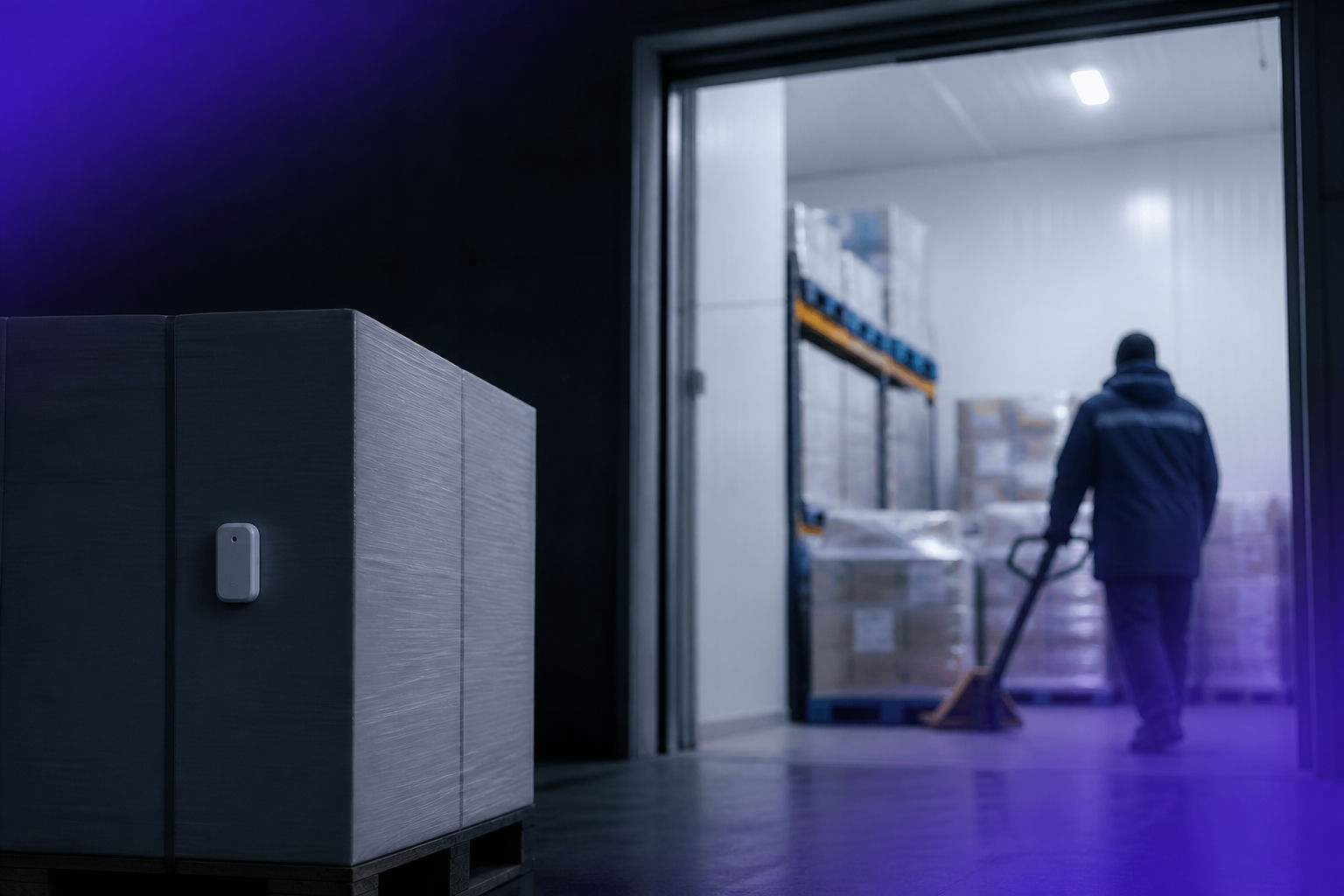
The proof has to cover the unscanned trip
The pros and cons point back to the capability that matters most for food: continuous condition monitoring. A food-distribution beacon project has to prove what happened between checkpoints, because quality failures often occur during dwell time, handoffs, or transport legs nobody scanned.
A location ping can tell you that a pallet moved from a DC to a store. Condition sensing tells you whether the product experienced a temperature or dwell problem during the unscanned parts of the trip. That is why buyers should evaluate the evidence path, not the beacon label.
The word beacon can mean different things
As of 2026, the word "beacon" is used in very different markets. For instance, CES 2026 coverage described wire-free mower navigation using lidar, dual-camera vision, and RTK (real-time kinematic) positioning beacons for navigation. That usage is real, but it does not solve the food-distribution problem. In cold chain, the buyer needs proof that physical products can be identified and monitored with condition data that survives handoffs, dwell time, and facility boundaries.
Wiliot is a Physical AI company that gives organizations continuous, scan-free visibility into the location and condition of every item in their supply chain. Battery-free IoT Pixels capture that data, and the Wiliot Physical AI Platform turns it into insights teams can act on, predicting problems like shrink, mis-ships, and spoilage, and recommending the next move. The practical test is whether IoT Pixels can make item-level visibility routine enough that quality and operations teams stop waiting for manual scan events to understand what happened.
Operating questions come before device labels
For a food distributor, that shifts the review from "Can the beacon be detected?" to better operating questions:
- Can it associate condition data with the right item, case, pallet, tote, or reusable container?
- Can it read without manual scans at the points where labor is already constrained?
- Can it show dwell, location, and condition together?
- Can it support spoilage, mis-ship, and receiving workflows without creating another dashboard nobody checks?
- Can it feed inventory accuracy and exception processes with real-world data?
That last point matters because temperature monitoring alone can become another silo. The better implementation connects condition signals to inventory availability, shipment verification, receiving, and loss prevention. For cold-chain teams, temperature monitoring should sit inside the same operating picture as inventory and asset movement, because bad decisions rarely come from missing one data point. They come from missing the relationship between product, condition, place, and time.
Who are BLE beacons for and who should wait?
The buying decision is straightforward once the evidence path is the standard. Battery-free BLE beacons are a strong fit for food distributors that feel blind spots between receiving, storage, dispatch, delivery, and store or restaurant intake.
They are especially suited to teams that manage:
- Cold-chain products where condition history affects release, claims, or waste.
- Reusable pallets, totes, crates, trays, roll cages, or containers.
- Multi-site distribution where dwell time and handoff accuracy are hard to prove.
- High-volume receiving or dispatch workflows where manual scans create delay.
- Quality programs that need evidence before deciding whether to hold, release, or investigate product.
Teams should wait if they cannot act on the data yet. If nobody owns exception handling, if core inventory records are unreliable, or if the operation has no way to connect condition events to shipment and product records, the first investment may need to be process design rather than more sensors.
The next step is direct: build the buying case around evidence. Ask vendors to prove item-level visibility, scan-free reads, battery-free operation, condition history, and integration into the workflows where food decisions are made. If they can only show dots on a map, they have not answered the cold-chain question.
Frequently asked questions
What are the best Bluetooth Low Energy beacons for food distribution monitoring?
The best option for food distribution is a battery-free BLE beacon model that supports continuous condition sensing and item-level visibility across cold-chain handoffs. For practical buying, the deciding factor is the Bluetooth label alone. The real test is whether the beacon can keep physical products readable without adding a per-tag battery-maintenance program. Source: IoT Pixels
How do BLE beacons provide continuous temperature data across the cold chain?
BLE beacons support cold-chain monitoring by making products, cases, pallets, or reusable assets readable as they move through facilities and handoffs. In a battery-free IoT Pixel model, the goal is scan-free condition data that can be tied to the item and used by quality teams when temperature or dwell exceptions appear. Source: Temperature Monitoring
What makes a BLE beacon better than active RFID for item-level cold chain tracking?
Do not frame the choice as BLE beating active RFID in every case. As of 2026, supply-chain RTLS deployments include BLE beacons, UWB beacons, and RFID options, and each has a role. For item-level cold-chain monitoring, the advantage of battery-free BLE is the ability to support continuous condition sensing and item-level visibility without the operating burden of maintaining batteries on every tag. Source: Physical AI platform
Sources
Every reference cited on this page, in the order Wiliot evidence, related articles, then outside research.
- 1.IoT Pixels (wiliot.com)
- 2.temperature monitoring (wiliot.com)
- 3.Bluetooth Low Energy (BLE) beacons are a low-cost, micro-location-based technology used for communication (en.wikipedia.org)
- 4.Why battery-free BLE beacons are a top choice for food distribution monitoring (kkkcdzmhnnqevxhexzpo.supabase.co)
- 5.RTLS options include BLE beacons, UWB beacons, active RFID, and passive RFID (logisticsmgmt.com)
- 6.How we evaluated BLE beacons for cold chain (kkkcdzmhnnqevxhexzpo.supabase.co)
- 7.RTK (real-time kinematic) positioning beacons for navigation (cnet.com)