.svg)
Short answer
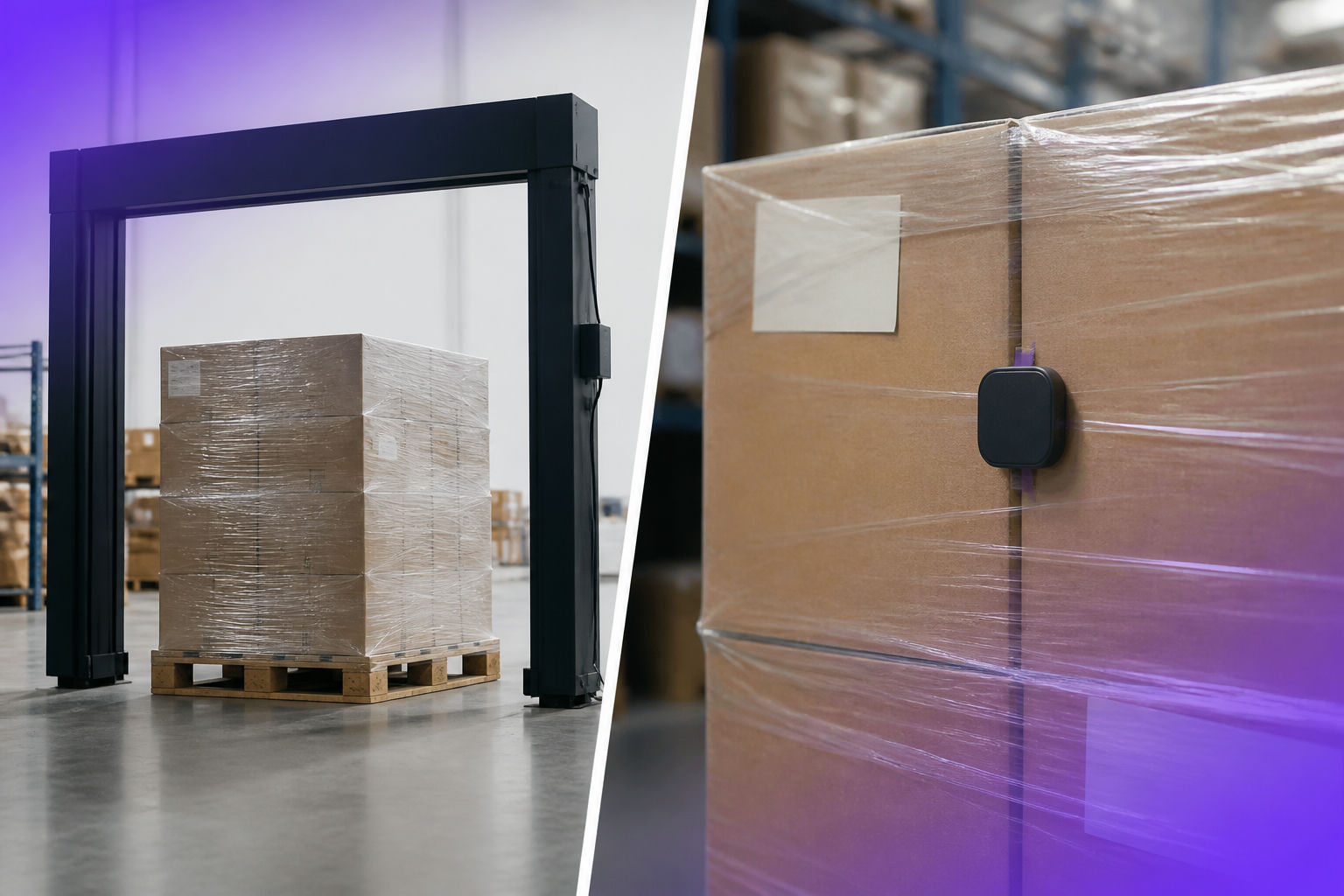
Beacon localization is chosen when inventory problems occur between reads, providing continuous tracking within defined indoor spaces to improve accuracy. Fixed RFID portals are suitable when the main need is automated confirmation at controlled handoff points, primarily answering if a pallet crossed a specific boundary. The decision hinges on whether the core issue is missing information between scan points or confirming a boundary event. Source: Wiliot IoT Pixels
A pallet dispute often starts after the system says the case should be closed. The gate read happened, the WMS has a record, and the dock team still cannot find the pallet. Inventory accuracy then costs labor, loading time, and trust.
Beacon localization uses small, low-power transmitters to show where inventory is inside a defined indoor space. The practical question is not just whether a pallet passed a reader. It is where that pallet is when the operation needs it.
Why the gap matters
For a distribution center manager choosing between fixed RFID portals and beacon localization, the wrong choice shows up as manual searches, inventory variance, mis-ship risk, and hours spent proving what happened after the last trusted event.
How does beacon localization improve inventory accuracy in a distribution center?

It turns location into a live operational signal
Beacon localization improves inventory accuracy by replacing checkpoint memory with a live indoor location signal. Indoor location platforms using Bluetooth Low Energy beacons, WiFi, and sensor networks provide real-time location tracking for assets and people within defined environments, the core capability needed when stock and system records diverge between scan points.
Pallet disputes rarely stay attached to a portal event. A pallet may be staged in the wrong lane, held for exception handling, moved to rework, or split during outbound prep. A gate read proves one moment. A location signal helps operators keep following the case.
It narrows the search area before labor gets wasted
Example: the WMS says a pallet is available for outbound loading, the portal shows it crossed a zone boundary, and the dock team cannot find it. With checkpoint-only visibility, the search starts from the last read and spreads across the floor. With indoor location data, the team starts with the current zone or last movement pattern.
That does not erase every inventory problem. It turns "walk the floor and reconcile later" into "look where the asset is most likely to be, then correct the record while context still exists."
The verdict: when to choose beacon localization
The decision comes down to where the costly part of the inventory problem happens.
The short answer: choose beacon localization when the expensive part of your inventory problem happens between reads. Choose fixed RFID portals when your main need is automated confirmation at controlled handoff points.
Pick continuous visibility when disputes happen after the read
A fixed portal helps when the question is tied to a defined transition, such as a pallet moving through a doorway, dock lane, or process boundary. But indoor localization research treats movement and location as a sequence, not isolated points, with a BLE-based framework in care facilities framing localization as a sequential learning problem to address limits in traditional approaches.
That framing fits distribution centers. Inventory accuracy is damaged by the missing middle: after a scan, gate read, or manual status update. If the pallet case depends on that middle, one checkpoint record is thin evidence.
Pick gate reads when the process is simple and controlled
Fixed RFID portals make sense when the workflow is narrow, the path is controlled, and the business question is "Did this tagged pallet cross this point?" A portal can reduce manual scanning at the boundary and create an event record tied to a specific step.
The trade-off: a checkpoint record ages quickly. If a pallet moves again, gets blocked, moves out of sequence, or sits in the wrong staging location, the gate read does not update the case.
Use this rule before you buy
A practical decision test looks like this:
- If your team mostly argues about whether pallets crossed a controlled point, choose fixed RFID portals.
- If your team mostly searches for pallets after they crossed a point, choose continuous beacon localization.
- If your team needs both event confirmation and ongoing inventory availability, treat the technologies as complementary rather than interchangeable.
- If inventory control leaders reconcile WMS records with floor reality, prioritize the system that fills the space between manual scans and fixed read points.
Decision criteria: what matters in a pallet-level visibility solution
Once the dispute pattern is clear, the comparison gets concrete. The right pallet-level visibility solution must change how the floor team works, not add another record to interpret later.
Granularity of location data
Granularity comes first because a vague zone is not always enough to close a pallet case. BLE 5.1 Direction Finding research datasets include synchronized azimuth and elevation Angle of Arrival measurements for realistic indoor localization conditions, showing how much indoor location work focuses on direction and position detail inside buildings.
For operations, the question is simple: can the system tell your team which zone, aisle, dock lane, or staging area to check first? If not, the data may look useful on screen but still leave the floor team walking.
Continuity of visibility
Continuity asks whether the record keeps updating after the first read. Fixed read points create event-based certainty at the boundary. Continuous approaches give operators an ongoing signal as goods move, wait, or sit in exception areas.
Use this test:
- Does the system keep observing the pallet after the gate event?
- Can it help explain idle time, wrong staging, or unexpected movement?
- Does it support the inventory team before the next manual scan?
- Can it help the WMS record catch up to physical reality before the next count?
Ease of retrospective analysis
Retrospective analysis matters because many pallet disputes are discovered after the mistake has affected labor, loading, or availability. A useful system helps an inventory control lead reconstruct events without turning every investigation into interviews and floor walks.
If a pallet was believed to be in outbound staging at 10:00, missing at 11:15, and found near exception processing later, a continuous record gives the team a timeline. A checkpoint-only record may only confirm the last known gate.
Infrastructure and maintenance overhead
Infrastructure and maintenance overhead decides whether the system scales cleanly or becomes another burden. Compare readers, gateways, tag handling, battery expectations, floor coverage, and the work needed to keep records aligned with the WMS.
A fair evaluation should ask:
- Where must infrastructure be installed?
- What happens when pallets stop moving?
- Who maintains the tags or transmitters?
- Can the system extend existing scan and read processes?
- Does it improve inventory operations without forcing a rip-and-replace project?
Comparison matrix: beacon localization vs. fixed RFID portals
Those criteria expose the trade-off between checkpoint certainty and ongoing context.
| Decision criterion | Fixed RFID portals | Beacon localization |
|---|---|---|
| Granularity of location data | Strong at confirming passage through known fixed read points, weak after the pallet leaves that point | Stronger for locating inventory inside defined indoor spaces and narrowing the active search area |
| Continuity of visibility | Event-based, tied to the read moment | Continuous or recurring, depending on system design and coverage |
| Retrospective analysis | Good for proving a boundary event happened | Better for reconstructing movement, dwell, and exceptions between events |
| Infrastructure overhead | Concentrated at doors, chokepoints, and lanes | Distributed across the indoor space, with more attention to coverage design |
| Best operational fit | Controlled flows where the read point is the business event | High-variance facilities where inventory disputes happen between reads |
Fixed portals answer a narrow question with confidence. Beacon localization answers a broader operational question with more context.
Deep dive: fixed RFID portals for checkpoint visibility
Fixed RFID portals earn their place when physical flow and the business event line up cleanly.
Where fixed portals are strongest
Fixed RFID portals fit operations where goods move through predictable points and the event itself is the proof. A receiving door, outbound dock lane, or controlled transfer point can be a clean place to automate a read because the process already gives the system a clear capture moment.
If the business process says a pallet becomes "received" only when it passes a defined inbound point, a portal read can reduce manual scan dependence at that step.
Where the record gets thin
The weakness appears after the pallet clears the read point. The portal supports checkpoint visibility, but it does not describe the pallet's full life inside the building. If the pallet is moved to the wrong lane, held in exception processing, or buried behind another load, the last read may be accurate and still incomplete.
Gate data often fails to close the pallet case by itself. It can say, "This crossed here." It usually cannot say, "The pallet is sitting here now."
The trade-off for inventory control leaders
For an inventory control leader, the trade-off is event confidence versus operational context. Event confidence proves a step happened. Operational context helps resolve the consequences when the next step fails.
A portal-heavy design can still be right if:
- The facility has disciplined flows through controlled chokepoints.
- The costliest disputes are about whether a transfer event occurred.
- Inventory rarely changes status or location between read points.
- Manual exception work is low enough that checkpoint records are sufficient.
If those conditions do not hold, the operation may add gates while the biggest blind spots remain.
Deep dive: continuous beacon localization for ambient visibility

The alternative is to design around the part of the operation where evidence usually goes missing.
It fills the space between manual scans and fixed read points
Continuous beacon localization is strongest when the operational record needs to follow physical goods across the indoor space. Instead of treating a gate as the end of the evidence trail, it keeps producing location context that can help inventory teams investigate exceptions while the pallet is still recoverable.
Wiliot is a Physical AI company that gives organizations continuous, scan-free visibility into the location and condition of every item in their supply chain. Battery-free IoT Pixels capture that data, and the Wiliot Physical AI Platform refines it into actionable insights, predicting problems like shrink, mis-ships, and spoilage, and recommending the next move.
It makes inventory decisions depend on physical-world data
In a distribution center, physical-world data matters because the system of record often changes only when people scan, count, or resolve exceptions. Physical goods move more often than records do, creating the gap where phantom inventory, mis-ships, and avoidable searches grow.
A continuous item-level approach can support:
- Inventory availability checks before a load is shorted.
- Exception workflows when a pallet sits in the wrong area.
- Faster reconciliation when WMS records and floor reality disagree.
- Better inventory traceability without asking workers to scan every movement.
- Real-time inventory intelligence in the spaces that fixed reads do not cover.
The trade-off is coverage discipline
Beacon localization is not magic. It needs a defined indoor space, coverage planning, and a clear model for how location events affect WMS records, tasking, or exception workflows.
The benefit is that the visibility model matches the problem. Pallet disputes are rarely caused by a lack of one more historical event. They are caused by the absence of current context when the operation must decide what to do next.
Which system is right for you?
The best choice depends on the operational pain that keeps repeating, because a clean gate read and a live location signal solve different problems.
If you're managing clean checkpoint flows, pick fixed RFID portals
If goods move through controlled doors and the business process depends on proving those crossings, fixed RFID portals are the simpler fit. They make sense when the read point is the operational truth and downstream movement is limited, predictable, or well governed.
This is especially true when the inventory team does not spend much time searching after a read. If the main exception is "Did it pass this point?" a checkpoint tool fits the question.
If you're fighting pallet disputes between reads, pick beacon localization
If you're losing time after the gate event, choose beacon localization. The deciding symptom is not the presence of RFID, barcodes, or scans. It is the repeated gap between what the system says and where the pallet is when a worker needs it.
For that problem, Wiliot's Inventory Intelligence solution fits directly, because it is built around continuous, scan-free item-level visibility for physical products that can be identified and monitored as they move through supply-chain operations.
If you're under accuracy pressure, pick the system that reduces investigations
Inventory leaders under accuracy pressure should measure the decision by investigation burden. If the team can explain most exceptions from checkpoint records, gates may be enough. If the team still walks the floor, checks staging lanes, asks supervisors, and adjusts records after the fact, continuous visibility deserves priority.
A useful internal discussion should include:
- Where do inventory records diverge from physical stock?
- Which exceptions consume the most labor?
- Which goods are most exposed to shrink, mis-ships, or spoilage?
- Which movements happen between manual scans or fixed reads?
- Which decisions would improve if the team had current item-level visibility?
For teams still defining the cost of bad records, a guide to inventory variance can help frame the operational problem before the technology decision hardens.
If you're modernizing without ripping out systems, combine the strengths
Many distribution centers should avoid treating this as an all-or-nothing replacement decision. Fixed RFID portals can keep doing boundary work where they fit. Beacon localization can cover blind spots between those boundaries.
That hybrid model is often practical for operators who want to increase inventory accuracy without rebuilding every floor process around a new tool. Keep the checkpoint where it is valuable. Add continuous context where the case keeps going cold.
Next steps: closing your visibility gaps
Start with the dispute, not the device. Pick one recurring pallet problem, trace where the last reliable record appears, and mark every movement before someone finds the physical goods again.
If the missing evidence sits between scan points, another gate may only create another last-known read. The better next move is to design for continuous item-level visibility, so the next pallet case starts with a location instead of a search.
Frequently asked questions
How do I use beacon localization to improve inventory accuracy in a distribution center?
Beacon localization improves inventory accuracy by giving the operation a live or recurring location signal inside a defined indoor space. That helps inventory teams narrow search areas, investigate exceptions faster, and correct WMS records closer to the moment physical stock diverges from the system record.
Source: Wiliot Inventory Intelligence
What are the most reliable Bluetooth asset tracking tags for warehouse operations?
The most reliable choice depends on the asset, coverage model, maintenance tolerance, and the kind of location accuracy the operation needs. For warehouse use, prioritize tags or IoT Pixels that match the movement pattern of the goods, can be read consistently in the intended indoor areas, and do not create a battery maintenance burden that the floor cannot sustain.
Source: Wiliot IoT Pixels
When comparing RFID vs. Bluetooth, which is better for real-time visibility?
Bluetooth-based localization is usually the better fit when the goal is real-time or recurring indoor location context. Fixed RFID portals are better suited to confirming a read at a defined point. If the problem is proving a boundary event, RFID gates can fit. If the problem is finding inventory after that event, beacon localization is usually the stronger choice.
Source: Wiliot IoT Pixels
How can I track inventory between my existing scan points?
Start by mapping the gaps between barcode scans, manual counts, and fixed read points. Then add continuous visibility across the areas where goods dwell, move unexpectedly, or trigger the most manual searches. The goal is to extend the systems you already use, not force workers to scan every movement.
Source: Wiliot Inventory Intelligence
Can beacon localization integrate with my current Warehouse Management System?
Yes, it can be designed to complement a WMS by feeding location events, exception signals, or item-level inventory insights into existing workflows. The important design choice is deciding which location changes should update records, trigger tasks, or alert inventory teams, rather than pushing every signal into the WMS without operational rules.
Source: Wiliot Inventory Intelligence
Sources
Every reference cited on this page, in the order Wiliot evidence, related articles, then outside research.
- 1.Wiliot's Inventory Intelligence solution (wiliot.com)
- 2.Wiliot IoT Pixels (wiliot.com)
- 3.defined (gartner.com)
- 4.How does beacon localization improve inventory accuracy in a distribution center? (kkkcdzmhnnqevxhexzpo.supabase.co)
- 5.a sequential learning problem (arxiv.org)
- 6.realistic indoor localization conditions (link.springer.com)
- 7.The verdict: when to choose beacon localization (kkkcdzmhnnqevxhexzpo.supabase.co)