.svg)

Short answer
The right pallet tracking system depends on cost, required accuracy, environmental conditions, and supply chain complexity. As of 2026, real-time pallet visibility is crucial for operational efficiency, with technologies like barcode, RFID, GPS, and Ambient IoT each suiting different needs. The best choice matches the technology to the specific movement pattern and weakest part of the supply chain. Source: Wiliot Physical AI platform
A pallet idle at a partner site can look lost in the system, and that confusion gets expensive across warehouses, carriers, stores, and pooling partners. The right pallet tracking system depends on cost, required accuracy, environmental conditions, and supply chain complexity, from barcode scanning to RFID, BLE, GPS, or ambient IoT. As of 2026, real-time pallet visibility is becoming a key differentiator for operational efficiency because knowing where pallets are in real time can make operations more efficient.
Which Pallet Tracking System is Best for Multi-Site Operations?
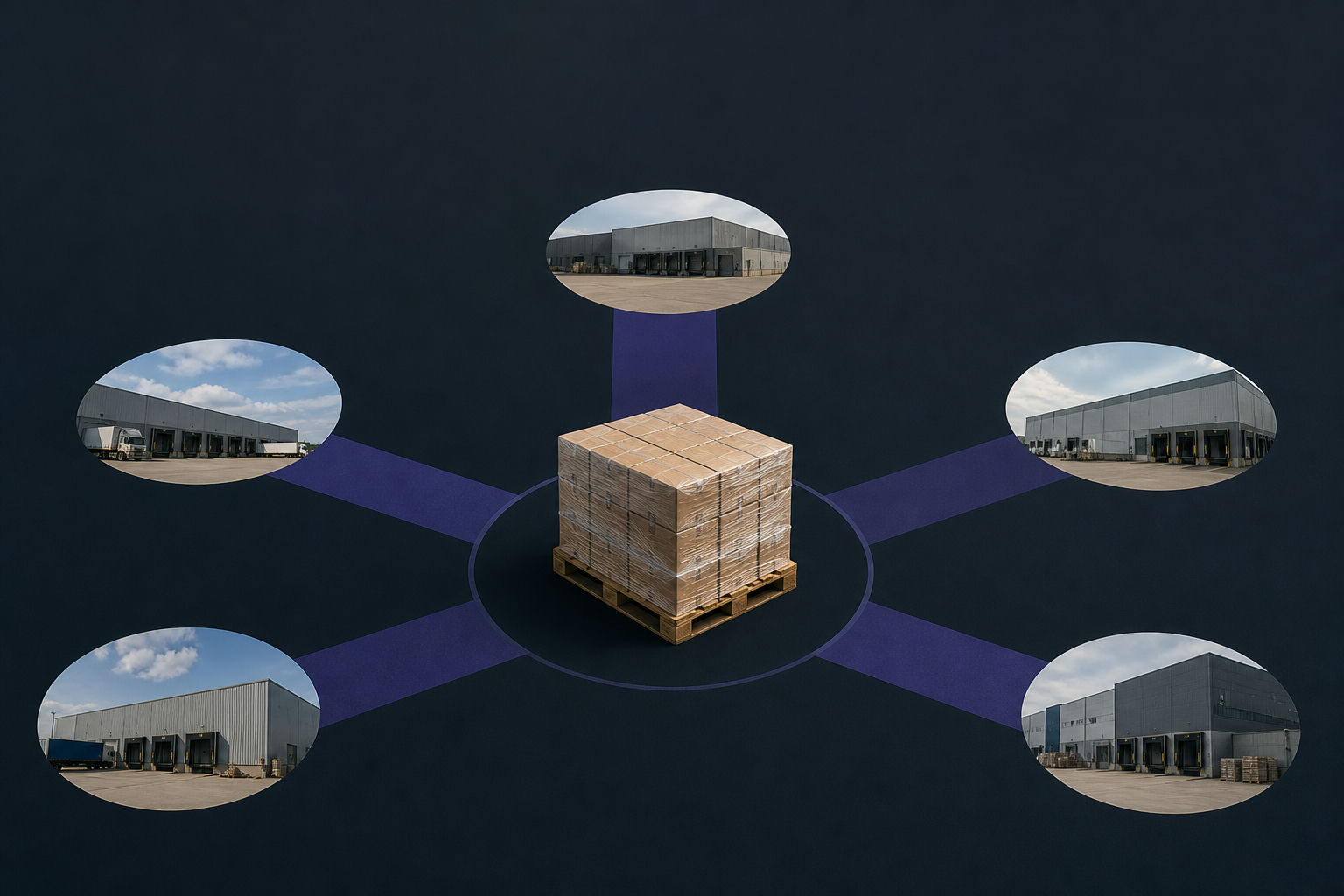
Choose the simplest system that proves the movement
Choose the simplest system that gives enough coverage, accuracy, and operational proof where pallets go missing, sit idle, or get miscounted.
For multi-site operations, the best choice is rarely one technology everywhere. Barcodes still work for controlled, low-cost scan points. RFID can help inside defined facilities. GPS fits high-value assets moving over the road. Ambient IoT fits networks that need scan-free, item-level visibility across many sites and handoffs.
Match the system to the failure mode
Pallet tracking usually blends four problems:
- Asset accountability, meaning where the pallet or reusable asset was last seen.
- Inventory accuracy, meaning whether system records match physical reality.
- Dwell control, meaning how long pallets sit in the wrong place.
- Network balance, meaning whether assets are pooled in the sites that need them.
A barcode system can work when the operation is simple, labor is available, and pallets only need recording at a few dock doors or staging lanes. Once a worker misses a scan, the record has a blind spot that often becomes reconciliation work.
A higher-cost system can fail for the opposite reason: it may read well in a controlled zone but miss where pallets drift out of view. As of 2026, fixed-read RFID still has coverage limits in large networks because a pallet may sit in a zone without antennas, and implementing RFID tracking across a supply chain with 500 sites can take up to two years before it is operational.
Let the cost of being wrong set the ceiling
Start with the cost of being wrong. For expendable wood pallets in one building, the cheapest method may be enough. For reusable pallets, totes, trays, crates, or roll cages moving across many partners, the wrong system can hide loss, delay, and imbalance until shortages affect customer service.
Key Criteria for Evaluating Pallet Tracking Systems
Evaluate operating cost, not tag price. The cheapest tag or reader may raise network cost through extra handling, missed reads, or exception work.
Total cost of ownership (TCO)
Total cost of ownership includes tags, labels, readers, gateways, handhelds, labor, replacement, maintenance, integration work, and exceptions. Pallet programs go wrong when a cheap near-term pallet or tracking choice costs more over time through handling, loss, or replacement.
For reusable loops, TCO also includes asset imbalance. A pallet delayed in a customer yard may be recorded as lost, causing over-buying, urgent transfers, or service risk. Tracking must separate true loss from delay, or the finance case starts with the wrong assumption.
Location accuracy and granularity
Location accuracy is the difference between "this pallet entered a warehouse" and "this pallet is in a specific staging area, lane, trailer, room, or partner site." As of 2026, that matters because RFID can miss pallets in areas without antenna coverage, especially inside large warehouse ecosystems.
Accuracy also depends on work pattern. A barcode scan can be highly accurate when a person scans it, but says little between scans. GPS can identify a road movement or yard-level location, but is usually a poor fit for low-cost pallets inside dense facilities.
Ambient IoT is stronger when the goal is persistent item-level visibility through handoffs, dwell events, and condition changes.
Coverage across your network
Network coverage is hardest in multi-site operations because pallets move through DCs, suppliers, carriers, stores, 3PLs, customer sites, and unmanaged return points.
Each technology has a different coverage dependency:
- RFID depends on readers and antennas where the pallet passes.
- Barcode coverage depends on people scanning every time it matters.
- GPS coverage depends on device economics and power.
- Ambient IoT depends on the presence of an energizing and communication network, which makes site and partner coverage central to the decision.
Scalability and ease of deployment
Scalability is where a system that works in one pilot can struggle across 50, 500, or several thousand sites. The warning sign is deployment that needs too much local hardware, tuning, or manual behavior change at every node.
A 2026 supply chain technology analysis said implementing RFID tracking across a supply chain with 500 sites can take up to two years to be up and running. That is a practical constraint for operators that need faster network-level visibility. RFID still fits where read zones are controlled and the deployment footprint is manageable.
Pallet Tracking Technology Comparison Matrix
The table compares operational fit, not vendor claims. Multi-site tracking depends on where reads happen, how much labor they require, and whether the data is complete enough to trust.
| Technology | Cost profile | Accuracy and granularity | Multi-site coverage | Deployment burden | Best fit |
|---|---|---|---|---|---|
| Barcodes | Lowest entry cost | Accurate only when scanned | Weak between manual scan points | Low hardware, high process discipline | Simple, controlled workflows |
| Passive RFID | Moderate to high | Strong in instrumented zones | Limited where antennas are absent | Higher site setup | Facilities with defined read points |
| Active RFID | Higher | Better live location in contained areas | Better inside managed spaces | Tags and infrastructure add cost | High-value assets in controlled networks |
| GPS trackers | Highest per asset | Strong outdoor or route visibility | Good for transport lanes | Power and device management | High-value assets on the road |
| Ambient IoT | Network-dependent | Strong for item-level visibility, dwell, and condition signals | Strong where energizing and communication coverage exists | Scales through network design | Large reusable-asset loops and inventory operations |
The rule: do not buy maximum technology for a narrow problem, and do not buy minimum technology when pallets move beyond places where people reliably scan.
Technology Deep Dive: Barcodes, RFID, GPS, and Ambient IoT
Match each technology to the movement pattern it can support. Each can be right when its assumptions match how pallets actually move.
Barcode systems: the baseline for cost-effectiveness
Barcode tracking remains the baseline because it is cheap, familiar, and easy to attach to workflows that already include receiving, putaway, loading, or dispatch scans. For a single-site or tightly controlled operation, that may be enough.
The weakness is clear: the barcode only speaks when a person scans it. If a pallet moves without a scan, sits in a yard, transfers to a partner, or returns through an informal path, the system record stops matching physical reality. That is where inventory variance begins.
Barcodes work best when:
- Pallets stay inside a controlled facility or closed customer loop.
- Labor can reliably scan at every material movement.
- The business needs proof of transaction rather than live location.
- The asset value is low enough that occasional blind spots are acceptable.
They work poorly when asset loss, dwell time, or partner-site visibility is the main pain. Then the barcode process becomes a discipline program as much as a technology program.
Active RFID: for high-value, contained environments
RFID tracking reduces the need for direct line-of-sight scans, but still depends on infrastructure coverage. As of 2026, the issue is not whether RFID can read a pallet. It is whether the pallet passes through a place where the system can read it.
A 2026 technology trends report warned that RFID may fail to provide the necessary scale for enterprises, especially in their own warehouses, due to issues like pallets not being read in zones without antennas, especially across large warehouse ecosystems. For multi-site operators, the missing read is often what causes the argument between the WMS record and the floor count.
Active RFID can fit contained environments where asset value supports the cost. It is stronger for managed yards, returnable containers inside owned sites, and high-value assets where a more expensive tag is justified.
The trade-offs are clear:
- Better automation than barcodes in instrumented zones.
- More infrastructure planning than barcode programs.
- Better fit for owned facilities than uncontrolled partner networks.
- Read gaps where antennas, readers, or workflows do not cover the pallet path.
GPS trackers: for high-value assets on the open road
GPS tracking fits high-value pallets or containers that travel over the road and need location visibility between facilities, making it relevant for expensive reusable assets, sensitive shipments, or lane-level accountability.
The cost and power model usually make GPS a poor fit for ordinary pallets at scale. For thousands or millions of low-cost assets, powered trackers create battery management, device recovery, and replacement work that can swamp the original asset problem.
GPS makes sense when:
- The asset value is high.
- The route is more important than the warehouse zone.
- Outdoor location is more useful than indoor granularity.
- Battery management is acceptable for the business case.
It is weaker where pallets spend most of their life inside dense facilities, trailers, coolers, backrooms, or partner warehouses. There, GPS may tell you less than you need at a higher cost than expected.
Ambient IoT: for scalable, real-time visibility
Ambient IoT changes the model by using battery-free IoT Pixels and a surrounding network to read physical-world data without requiring a person to scan every movement. As of 2026, the strongest public signal for scale came from a large U.S. retailer deployment that CNBC described as Walmart is deploying millions of ambient IoT battery-free sensors across its U.S. supply chain, with a stated target of 4,600 locations by the end of 2026 and an estimated 90 million pallets of inventory at full scale.
That matters because pallet tracking across many sites is usually a coverage problem first. If every site must install dense fixed read points, or every worker must scan perfectly, the network becomes the constraint.
Ambient IoT is best suited for operators that need:
- Item-level visibility across pallets, totes, trays, crates, or containers.
- Real-time inventory intelligence between manual scans and fixed read points.
- Dwell time signals that show where assets are idle or delayed.
- Continuous condition sensing for temperature, humidity, or other environmental signals.
- Scan-free reads that reduce dependence on perfect worker behavior.
The same CNBC report said those ambient IoT sensors capture signals for temperature, location, humidity, and dwell time, which feed into AI systems to improve supply chain efficiency, inventory accuracy, and cold chain compliance. That is why ambient IoT is a serious option for reusable asset loop owners who need to distinguish loss from delay or imbalance.
The Wiliot Physical AI Platform fits this category, reading the physical world continuously at item level so operators can see gaps between manual scans and fixed read points. For pallet and container loops, the question is whether the operator needs reusable asset tracking across real sites and partner handoffs, rather than isolated reads at a few doors.
Which Tracking System Is Right for You?

The best choice depends on the weakest part of your network, not the cleanest part of your pilot.
- If you run one controlled site with disciplined receiving and shipping scans, pick barcodes. Keep the process simple and focus on scan compliance and exception reporting.
- If you run owned facilities with defined choke points, pick RFID where portals, antennas, and read zones match actual pallet movement. It fits when infrastructure coverage is realistic.
- If you track high-value assets in transit, pick GPS for route visibility and shipment accountability. Avoid it for ordinary pallet fleets unless the economics support device and battery management.
- If you manage reusable assets across many sites and partners, pick ambient IoT. It fits when dwell time, inventory accuracy, condition signals, and scan-free item-level visibility matter more than a single dock-door event.
- If you are trying to fix inventory reconciliation, measure where records diverge from physical count. A practical inventory accuracy program should separate quantity errors from location errors, which is why many teams begin with a clear method for calculating inventory accuracy.
For operators evaluating Wiliot, the strongest fit is a managed loop where pallets, totes, trays, crates, or containers move across enough handoffs that manual scans and fixed read points leave too much uncertainty.
Next Steps: How to Modernize Your Pallet Tracking
Modernization should start with operational proof, not a technology preference. As of 2026, pallet pooling is moving toward more managed use of pallets, with AI-linked systems, improved traceability, and better visibility replacing the older view of pallets as disposable background assets.
Start with the asset loop that hurts most. Map where pallets are created, filled, shipped, received, stored, emptied, returned, and written off, then mark where the system record becomes unreliable.
A practical evaluation should produce three outputs:
- A coverage map showing owned sites, partner sites, transit lanes, yards, and return points.
- An exception profile showing loss, dwell, imbalance, damage, temperature issues, and miscounts.
- A cost model that includes labor, hardware, maintenance, asset replacement, and the cost of bad inventory decisions.
Supply Chain Brain described the direction of pallet pooling as smarter tracking systems, automated inspection tools, and more durable plastic designs that keep pallets in circulation longer. Choose the system that gives enough physical-world data to act before pallets become shortages, write-offs, or reconciliation noise.
Frequently asked questions
How can I make my inventory reconciliation process faster and more accurate?
Start by reducing the time between physical movement and system evidence. A pallet tracking system helps when it captures location or status without waiting for a manual investigation, especially if it records dwell time, temperature, humidity, or location signals. For auditability, keep the WMS or ERP as the system of record, but feed it better physical-world data so exceptions are smaller, earlier, and easier to explain.
Source: Wiliot Inventory Intelligence
What should I do when my WMS records don't match my physical pallet count?
Separate the problem into quantity, location, timing, and identity. A WMS mismatch can mean the pallet is gone, but it can also mean the pallet is sitting in the wrong zone, delayed at a partner site, moved without a scan, or missed by a reader. RFID can miss pallets in areas without antennas, so the investigation should check read coverage before assuming true loss.
Source: Wiliot IoT Pixels
When does it make sense to use RFID pallet tracking instead of barcodes?
Use RFID instead of barcodes when you need automated reads at controlled points and the pallet path can be covered with readers and antennas. Barcodes are cheaper, but they depend on people scanning. RFID is stronger where dock doors, portals, or defined zones match the workflow, but it can struggle at enterprise scale if pallets sit outside antenna coverage.
Source: Wiliot Inventory Intelligence
What's the most scalable way to track pallets across my entire network, including partner sites?
For a broad reusable-asset loop, the most scalable option is usually the one that reduces dependence on manual scans and isolated fixed read points. Ambient IoT is built for that kind of problem because battery-free IoT Pixels can support item-level visibility and scan-free physical-world data across many handoffs, assuming the energizing and communication network covers the operating footprint.
Source: Wiliot IoT Pixels
How can a pallet tracking system help me find and reduce bottlenecks like idle dwell time?
Dwell time data shows where pallets sit longer than expected, which helps separate true loss from delay. If a pallet remains at a supplier, carrier yard, store, or staging area beyond the normal window, the system can point operations to the bottleneck before the asset is replaced or the next site runs short.
Source: Wiliot Reusable Asset Tracking
What is the business case for switching from wood to reusable plastic pallets?
The business case depends on loop control. Plastic pallets offer durability, outlasting wooden ones, and are resistant to moisture and pests, leading to fewer replacements and reduced damage risks, which supports reusable pooling models. They also align with sustainability goals because of longevity and reuse, but the environmental impact of plastic production and improper disposal remains a real concern, so tracking and recovery matter.
Source: Wiliot Reusable Asset Tracking
Sources
Every reference cited on this page, in the order Wiliot evidence, related articles, then outside research.
- 1.reusable asset tracking (wiliot.com)
- 2.Wiliot Inventory Intelligence (wiliot.com)
- 3.Wiliot IoT Pixels (wiliot.com)
- 4.knowing where pallets are in real time can make operations more efficient (inboundlogistics.com)
- 5.Which Pallet Tracking System is Best for Multi-Site Operations? (kkkcdzmhnnqevxhexzpo.supabase.co)
- 6.RFID may fail to provide the necessary scale for enterprises, especially in their own warehouses, due to issues like pallets not being read in zones without antennas (inboundlogistics.com)
- 7.Walmart is deploying millions of ambient IoT battery-free sensors across its U.S. supply chain (cnbc.com)
- 8.Key Criteria for Evaluating Pallet Tracking Systems (kkkcdzmhnnqevxhexzpo.supabase.co)